
How Is AI Redefining SEO in 2026?
Published on
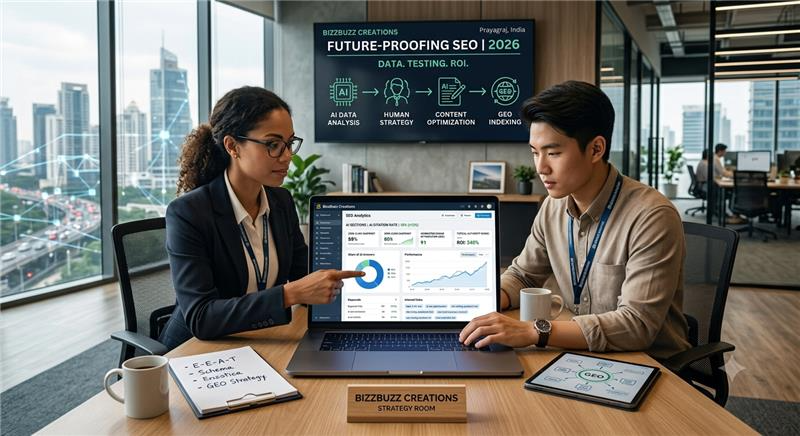
Search doesn’t work the way it did three years ago. Google now defaults to a conversational, LLM-driven search experience. People aren’t typing “best CRM software” anymore — they’re asking full questions and expecting full answers right on the results page.
This is where AI SEO optimization stops being a buzzword and starts being the actual job. Ranking in 2026 means understanding how AI models read, summarize, and cite content — not just how Google’s old crawler counted keywords.
SEO in 2025 vs. SEO in 2026: What Actually Changed
| Factor | SEO in 2025 | SEO in 2026 |
|---|---|---|
| Search interface | Keyword-based queries | Conversational, LLM-driven prompts |
| Primary ranking signal | Backlink volume, keyword density | Brand citations, factual depth, freshness |
| SERP experience | Ten blue links, occasional featured snippet | AI Overview answers most queries directly |
| Content goal | Rank on page one | Get cited inside the AI-generated answer |
| Content depth needed | Broad, keyword-optimized articles | Narrow, first-hand data and expertise |
| Update frequency | Periodic refreshes | Continuous updates tied to real-time data |
| Schema markup | Nice-to-have | Required for AI Overview eligibility |
| Success metric | Rankings, click-through rate | Citation rate, share of AI answers, ROI |
The short version: 2025 rewarded pages that were technically optimized. 2026 rewards pages that are actually worth quoting.
What Is Generative Engine Optimization (GEO)?
AI Overview Snippet- GEO is the practice of optimizing content so AI search engines cite and quote your brand directly in generated answers.
- It prioritizes brand authority, factual accuracy, and depth over backlink volume alone.
GEO is the natural evolution of SEO. Instead of chasing rankings on a list of ten blue links, you’re now competing to be the source an AI model trusts enough to quote by name. That changes what “good content” actually means.
Using AI in SEO today isn’t about mass-producing articles. It’s about feeding search engines original, well-structured information they can pull from with confidence. The brands doing this well combine AI-assisted writing with real human expertise, data, case studies, and opinions backed by results. The ones losing ground are publishing generic AI text that reads like everyone else’s generic AI text. Search engines can tell the difference, and so can readers.
If you’re picking up an AI writing assistant for your team, look for one that helps you go deeper on a topic, not one that just spins out more words. Speed without substance doesn’t rank anymore.
Winning in a Zero-Click World
AI Overview Snippet- AI Overviews now answer most informational queries directly on the search page.
- Ranking inside the citation links, not just the organic list, is what still drives real traffic.
Here’s the uncomfortable part: a huge share of searches now get answered before anyone clicks a website. Google’s AI Overview does the summarizing, and plenty of users stop right there.
But this isn’t the death of organic traffic — it’s a shift in what earns the click. AI Overviews still link out to sources for the “how” and “why” behind the answer. Your job is to be one of those sources. That means writing the kind of first-hand, specific, execution-level content that a two-paragraph AI summary literally can’t replace.
This is exactly why picking the right AI SEO tools matters more than ever. The right stack helps you identify which questions people are actually asking conversationally, then structure your content so it answers the surface-level question fast and rewards deeper reading with the details AI can’t fake.
Choosing the Right AI SEO Software (Without Wasting Your Budget)
There’s no shortage of tools claiming to be the best on the market, and most digital teams are testing several at once. A few things actually matter when you’re comparing options:
01 Research depthA good AI research tool should surface real search intent, not just keyword volume. 02 Content quality controlThe best writing assistants flag generic phrasing, not just grammar issues. 03 Editing, not just draftingGood AI writing platforms support human editing workflows instead of one-click publishing.A lot of teams start by using general-purpose AI to draft outlines, test headline variations, and generate meta descriptions. That’s a solid starting point. But treating it as your only tool is a mistake. Pair it with AI content optimization tools that check your draft against real ranking data, competitor gaps, and E-E-A-T signals before you hit publish.
From our deskAt BizzBuzz Creations, our internal testing across client campaigns shows a clear pattern: content built with a human-plus-AI workflow consistently outperforms fully automated drafts on both rankings and time-on-page. The gap isn’t small — it’s the difference between getting cited and getting ignored.
Future-Proofing Your Content Strategy
- Write for conversational queries. Structure headings as questions people would actually ask out loud.
- Add FAQ schema markup. It’s low effort and directly feeds AI Overview citations.
- Build brand mentions, not just backlinks. AI models weigh reputation signals across the web, not just linked domains.
- Update old content regularly. Freshness is now a ranking factor for AI-driven search, not just a nice-to-have.
None of this replaces solid writing. It just means the bar for “solid” moved up.
Frequently Asked Questions
What is the best AI for SEO right now?
There’s no single best tool — research, drafting, and technical audits each need a different tool.
Is there a free SEO writing assistant that actually works?
Yes. A free tool handles readability and keyword placement well; deeper analysis usually needs a paid tool.
Can I use ChatGPT for SEO content writing?
Yes — for outlines and first drafts, then edit for accuracy and brand voice before publishing.
What’s the best AI SEO tool for small agencies?
Look for tools that handle bulk audits, keyword tracking, and client reporting, not just single articles.
AI didn’t kill SEO. It raised the bar.
Thin content, keyword stuffing, and generic AI drafts don’t get cited anymore — real expertise does. BizzBuzz Creations builds content and SEO strategies around that reality: real data, real testing, and real ROI, not vanity metrics dressed up as progress.
Talk to our team See our SEO workWritten by
Khushi Gupta
Khushi Gupta is an SEO Executive and Content Writer specializing in keyword research, on-page optimization, and digital strategy.
Get Free Consultancy Now!
Ready to grow your business with trusted digital marketing services in UP? Contact Bizz Buzz Creations today and let’s build your success story together.