
Is Your Digital Marketing Agency Actually Growing Your Business — Or Just Burning Your Budget?
Published on
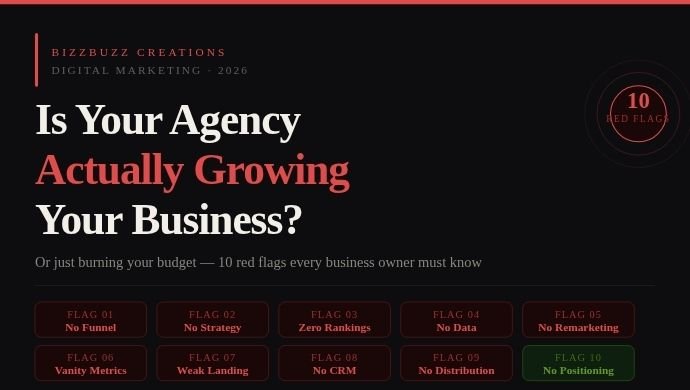
The Truth No Agency Wants You to Read
Let’s be honest with each other for a moment.
You hired a digital marketing agency because you wanted growth — more leads, more sales, more revenue. You signed the contract, paid the retainer, and waited.
But the results? Not what you expected.
So you asked questions. And you got answers like “it takes time” or “your brand awareness is growing” or “check the impressions this month.”
Meanwhile, your phone isn’t ringing any more than it was six months ago.
Here’s the reality that most agencies won’t put in a blog post: a significant number of businesses in India are paying for digital marketing that isn’t working — and most of them don’t know why.
This blog is going to change that.
By the time you finish reading, you’ll know exactly what a high-performing agency should be doing for you, what the red flags look like in real life, and most importantly — what you need to demand from anyone managing your marketing budget in 2026.
Think of your marketing budget as an investment, not a donation. It should earn you a rate of return. If it isn’t, something is wrong — and today, we’re going to diagnose what.
Why This Matters Even More in 2026
The digital marketing landscape has shifted dramatically this year. After the Google March 2026 Spam Update, agencies that were relying on shortcuts — AI-generated content without strategy, low-quality backlinks, fluffy reporting — got exposed. Their clients’ websites dropped. Their promises evaporated.
At the same time, Core Web Vitals became an even stronger ranking signal, meaning that technical performance and marketing strategy are now inseparable. You can’t have one without the other.
The agencies that are still operating on old models are quietly failing their clients. And those clients — business owners like you — deserve to know what’s going on.
Here are the 10 warning signs that your digital marketing agency is not delivering what you’re paying for.
10 Warning Signs Your Digital Marketing Agency Is Failing You
Warning Sign #1 — No Funnel Strategy (This Is Why Your Ads Are Not Converting)
Here’s the most common scenario we see: a business runs ads, messages come in on WhatsApp, and then those conversations simply die. No follow-up, no nurturing, no conversion.
This happens because there’s no funnel.
Every potential customer goes through three stages before they buy: Awareness (they discover you), Consideration (they evaluate you), and Conversion (they choose you). A good digital marketing agency builds content, ads, and touchpoints for all three stages.
When there’s no funnel strategy, your ads are essentially trying to force a marriage proposal on a first date. Most people aren’t ready to buy immediately — and that’s completely normal. The job of a funnel is to walk them from curious stranger to paying customer, step by step.
What your agency should be doing:
- Mapping out your customer’s full journey from awareness to purchase
- Running different ad types for cold, warm, and hot audiences
- Building retargeting sequences that re-engage people who showed interest but didn’t convert
- Creating lead magnets and nurturing flows that keep your brand top-of-mind
If your agency can’t show you a documented funnel strategy, that’s your first red flag.
Warning Sign #2 — No Creative Strategy (Your Content Is Posting but Not Converting)
Random posts. Festive graphics. Generic “motivational Monday” content. And zero engagement that actually leads to business.
Sound familiar?
Here’s the thing about content in 2026: the bar is much higher than it used to be. Every industry is crowded with content. The businesses that break through are the ones with a deliberate creative strategy — content that has a hook, tells a story, and guides the viewer toward a specific action.
Your content should be doing three jobs simultaneously: attracting the right people, engaging them with something genuinely valuable, and nudging them toward conversion. If your content is only doing one of those things (usually the “posting something” part), you’re creating digital noise instead of digital assets.
What a real creative strategy looks like:
- Defined content pillars based on what your audience actually cares about
- A Reels strategy built around hooks that stop the scroll within the first 3 seconds
- Content mapped to different stages of the buyer journey
- Clear calls-to-action on every piece of content that has a conversion goal
The goal isn’t to look busy. The goal is to build an audience that trusts you enough to buy from you.
Warning Sign #3 — SEO Is Happening but Rankings Aren’t (Why Your Website Isn’t Appearing on Google)
You’re being told SEO is being done. Reports show keyword tracking, on-page updates, maybe a few blog posts. But your website isn’t ranking for anything meaningful, and organic traffic is flat.
This is one of the most common forms of “busy work” we see in the industry.
SEO that doesn’t produce rankings isn’t SEO — it’s theatre. The reason this happens is usually one of three things: weak technical SEO (your website has Core Web Vitals issues, crawlability problems, or slow load speeds), poor keyword strategy (targeting keywords that are either too competitive or have no commercial intent), or inconsistent content output (a few blogs published and then months of silence).
We wrote extensively about why Core Web Vitals are now a critical part of your SEO performance in 2026 — and if your agency isn’t addressing technical performance alongside content, they’re doing half a job.
What to demand from your agency:
- A keyword research report that shows search volume, competition level, and commercial intent for every target keyword
- Monthly on-page optimization reports with specific changes documented
- A blog and content calendar with consistent publishing frequency
- Google Search Console access so you can verify performance with your own eyes
SEO is a long-term strategy — that’s true. But “long-term” doesn’t mean “you’ll never see data.” You should see movement in rankings within 3–4 months for lower-competition keywords, and steady progress should be visible and measurable every month.
Warning Sign #4 — “Results Take Time” With Zero Data to Back It Up
Let’s give credit where it’s due: results do take time in digital marketing. SEO takes months. Brand building takes quarters. This is genuinely true.
But “results take time” stops being a valid reason and starts being an excuse the moment it comes without a timeline, a benchmark, or any data showing that progress is actually happening.
If your agency cannot show you:
- How many leads came in this month vs. last month
- What each lead cost to acquire
- Which campaigns are performing and which aren’t
- What specific improvements were made and why
Then you aren’t dealing with a slow strategy. You’re dealing with a transparency problem. And a transparency problem usually means one thing: the work isn’t actually being done, or it isn’t working and the agency doesn’t want to admit it.
What good reporting looks like:
- A monthly report with actual lead numbers, cost-per-lead, and revenue attribution
- A clear explanation of what was tested, what worked, and what’s being adjusted
- Access to your own Google Analytics, Google Ads, and Meta Ads accounts (your data belongs to you — never let an agency lock you out)
- A documented roadmap with quarterly milestones
Data is not optional. It’s the entire basis on which marketing decisions should be made.
Warning Sign #5 — No Remarketing Strategy (You’re Paying to Acquire Leads Twice)
This one quietly costs businesses enormous amounts of money, and most business owners don’t even realize it’s happening.
Here’s a stat worth sitting with: 80% of people don’t buy the first time they encounter a brand. They need multiple touchpoints — maybe they visit your website, see your ad, forget about you, remember you a week later, and then finally convert.
Remarketing (also called retargeting) is the strategy that makes those multiple touchpoints happen. It uses tools like Facebook Pixel and Google Tags to track people who’ve already shown interest in your business and then serves them targeted ads designed to bring them back.
If your agency is exclusively focused on finding new people — cold audiences every campaign, no retargeting, no warm audience strategy — you are throwing money away on expensive new customer acquisition while your hottest leads simply go cold.
What a remarketing strategy should include:
- Facebook Pixel and Google Tags installed and verified on your website
- Custom audiences built from website visitors, video viewers, and past customers
- Remarketing ads with different messaging designed for warm audiences (people who already know you)
- Email sequences and WhatsApp follow-up flows for leads who expressed interest but didn’t convert
Acquiring a new customer costs 5–7 times more than converting someone who already knows you. Remarketing is not optional — it’s one of the highest-ROI activities in all of digital marketing.
Warning Sign #6 — Brand Awareness Is Growing but Revenue Isn’t (The Vanity Metrics Problem)
Every month, the report looks great. Reach is up. Impressions are higher. Engagement is growing.
And your bank account looks exactly the same.
This is the vanity metrics trap, and it’s one of the most sophisticated ways agencies disguise inactivity. Reach and impressions are easy to generate. Boosting a post to a broad audience will get you thousands of impressions. But impressions don’t pay your rent.
The metrics that actually matter are lead volume, cost per lead, conversion rate, and revenue attributable to marketing activity. If your reports don’t include these numbers, your agency is either not measuring them (a major problem) or deliberately keeping them out of the report (a bigger problem).
What to insist on:
- Conversion tracking set up on every important action (form fills, calls, WhatsApp messages, purchases)
- An attribution model that connects marketing touchpoints to actual sales
- Clear separation between “awareness” campaigns and “conversion” campaigns — with the appropriate metrics tracked for each
- Monthly revenue impact reporting, not just reach and engagement
Awareness has value — but only when it’s connected to a funnel that converts that awareness into revenue. Awareness alone is not a business outcome.
Warning Sign #7 — Your Landing Page Is Being Ignored (The Leaking Bucket Problem)
Imagine filling a bucket with water, except the bucket has a hole in the bottom.
That’s exactly what happens when your agency drives traffic to a slow, confusing, or poorly designed landing page.
You can have the world’s best ads, perfect targeting, and compelling creative — but if the landing page loads in 5 seconds, doesn’t clearly explain what you offer, has no social proof, or isn’t optimized for mobile, visitors will leave. And every visitor who leaves without converting is money wasted.
This is called Conversion Rate Optimization (CRO), and it’s a discipline that most agencies don’t invest in because it requires design skill, testing, and genuine analysis — not just running ads and hoping for the best.
The Google March 2026 algorithm update also made page experience a stronger ranking factor. A slow landing page doesn’t just lose conversions — it also signals to Google that your site provides a poor user experience, which hurts your ad Quality Score and your organic rankings simultaneously.
What a high-converting landing page needs:
- Load time under 2.5 seconds on mobile (LCP under 2.5 seconds — a Core Web Vitals requirement)
- A clear, compelling headline that addresses the visitor’s specific problem
- Social proof: real testimonials, case studies, client logos, or verifiable results
- A single, prominent call-to-action that tells the visitor exactly what to do next
- Mobile-first design that works flawlessly on every device
If your agency is managing your ads but has never discussed your landing page performance with you, they are filling a leaking bucket and charging you for the water.
Warning Sign #8 — Leads Are Coming In but No One Is Following Up (The CRM Gap)
This one hurts because it means the marketing is partially working — leads are being generated — but the system to convert them into customers doesn’t exist.
Without a proper lead management system, here’s what typically happens: a lead comes in through a WhatsApp message, it gets a reply three days later, the lead has already hired someone else. Or a lead fills out a form, the notification goes to an inbox no one checks daily, and it goes cold.
A CRM (Customer Relationship Management) system solves this by organizing every lead, tracking where they are in the sales process, automating follow-up sequences, and ensuring no lead falls through the cracks.
The marketing agency’s job doesn’t end at lead generation. A full-service agency should help you build the infrastructure to convert those leads into customers — or at minimum, audit whether your current follow-up system is strong enough to handle the leads they’re generating.
What a proper lead management system includes:
- A CRM tool (HubSpot, Zoho CRM, or even a well-configured spreadsheet for smaller businesses)
- Automated WhatsApp or email sequences that trigger immediately when a lead comes in
- Lead scoring to prioritize the hottest opportunities
- A clear SLA (Service Level Agreement) for response time — ideally under 5 minutes for hot leads
Our digital marketing services include CRM integration and lead management setup because we know that a lead without a follow-up system is just an expensive missed opportunity.
Warning Sign #9 — Content Is Being Created but No One Is Seeing It (The Distribution Problem)
Great content that no one sees is just a creative writing exercise.
If your agency is producing blogs, reels, carousels, and posts — but doing nothing to distribute that content beyond posting it organically — they are leaving most of its potential value on the table.
In 2026, organic reach on social media platforms is limited. Instagram and Facebook show your posts to a small percentage of your followers unless there is paid amplification behind it. Your blog posts will sit on page 10 of Google unless there is a genuine SEO and link-building strategy pushing them up.
Content distribution is its own discipline, and it requires a combination of paid amplification, cross-platform syndication, influencer collaborations, and strategic backlinking through methods like guest posting — which we use ourselves to build authority for our clients.
What a real content distribution strategy looks like:
- Paid content amplification (boosting top-performing organic content with a small ad budget)
- Cross-platform publishing: a blog becomes a LinkedIn post, a reel, a carousel, and an email newsletter
- Influencer and collaboration strategy to reach new audiences
- SEO-driven link building to increase the organic reach of your written content over time
Content without distribution is a tree falling in a forest with no one around to hear it.
Warning Sign #10 — Your Brand Looks Like Every Other Brand in Your Industry (No Positioning)
Posts are going up. Ads are running. But when someone sees your brand next to a competitor’s brand, they can’t tell the difference.
This is the brand positioning problem, and it’s far more damaging than most business owners realize. When your brand doesn’t stand out, you default to competing on price. And competing on price is a race to the bottom that no business wins long-term.
Strong brand positioning means you have a clear USP (Unique Selling Proposition) — a specific answer to the question: “Why should I choose you over everyone else?” It means your brand voice is consistent and recognizable across every platform. It means your messaging speaks directly to your ideal customer’s specific pain points and desires, not just generic industry language.
Without brand positioning, even if your ads drive traffic and your SEO improves your rankings, you’ll still lose customers at the decision stage because nothing about your brand compelled them to choose you specifically.
What strong brand positioning requires:
- A clearly articulated USP that your audience genuinely cares about
- A documented brand voice guide so every piece of content sounds like you
- Consistent visual identity across all platforms (colors, fonts, imagery style)
- Messaging that addresses your ideal customer’s specific problems — not generic industry claims
- Regular brand audits to ensure positioning stays relevant as the market evolves
Quick Self-Audit: How Many of These Apply to Your Business?
Go through this checklist honestly. Tick every box that applies to your current situation:
| Check | Red Flag |
|---|---|
 | Running ads but getting little to no conversions |
| Content being posted without a clear strategy or goal |
| SEO being done but not ranking on Google for important keywords |
| Being told “results take time” without any data, timeline, or progress proof |
| No retargeting ads running — warm audiences completely ignored |
| Monthly reports only show reach, impressions, and likes — no revenue data |
| Website or landing page loads slowly or doesn’t convert visitors |
| Leads coming in but no proper follow-up or tracking system |
| Content being created but getting little to no push behind it |
| Brand looks and sounds similar to competitors — no clear identity |
Written by
Shreya
-Hii, I am SEO specialist skilled in optimizing websites, enhancing online visibility, and driving organic growth through strategic keyword research and content optimization.
Get Free Consultancy Now!
Ready to grow your business with trusted digital marketing services in UP? Contact Bizz Buzz Creations today and let’s build your success story together.