
How to Rank in Google AI Results & Boost Organic Traffic (2026 Guide)
Published on
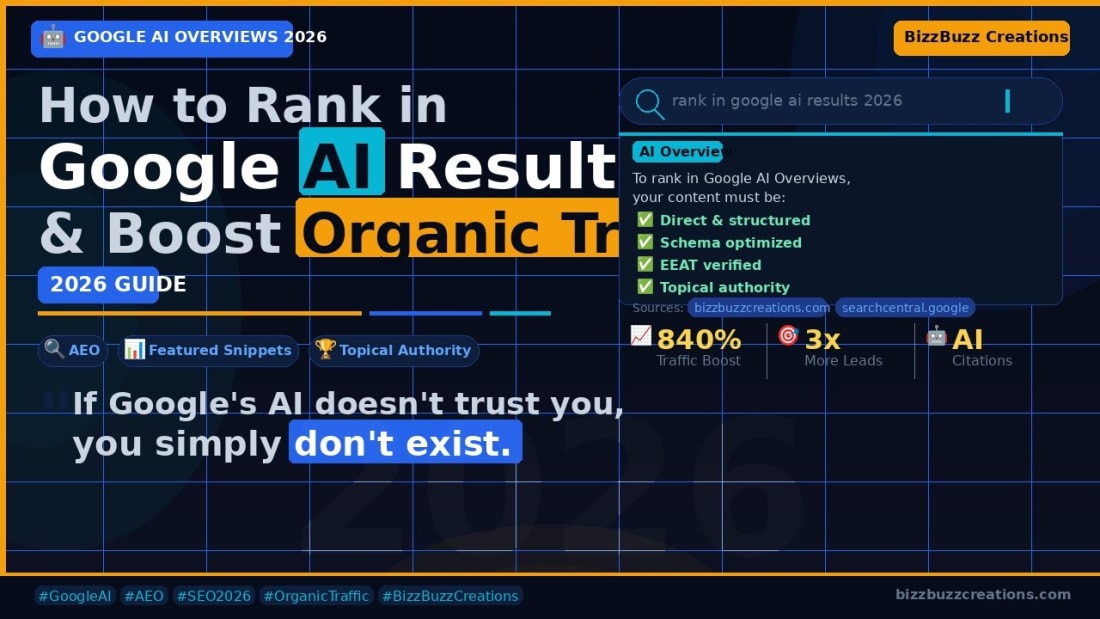
Introduction: Google Just Changed the Rules — Again
Let me be honest with you.
The SEO strategies that worked in 2023 are not going to cut it in 2026.
I’ve seen websites with great content, solid backlinks, and perfect on-page SEO — suddenly losing traffic. Not because they did something wrong. But because Google fundamentally changed how it shows results.
Enter Google AI Overviews.
If you’ve searched anything recently, you’ve probably noticed it — a large AI-generated answer sitting right at the top of the page, above everything else. Above ads. Above featured snippets. Above the #1 ranked website.
And here’s the uncomfortable truth:
If your content isn’t feeding Google’s AI — you’re invisible.
But here’s the good news — this shift is actually an opportunity if you know how to work with it.
In this guide I’m going to show you exactly how to rank in Google AI results, show up in featured snippets, and build the kind of organic traffic that compounds over time — not just spikes after publishing.
Let’s get into it.
What Are Google AI Overviews? (And Why They Matter)
Google AI Overviews — previously known as Search Generative Experience (SGE) — are AI-generated summaries that appear at the top of Google search results for certain queries.
Instead of showing you ten blue links, Google now reads multiple sources, synthesizes the information, and presents a direct answer — right there on the results page.
Here’s what makes this critical for your website:
65% of searches now end without a single click.
That means the majority of your potential visitors are getting their answer from Google’s AI — and never visiting your website at all.
But — and this is the key insight most people miss —
Google’s AI has to get that information from somewhere.
It pulls from websites it trusts. Websites with strong EEAT signals, clear structured content, and direct answers to real questions.
Your goal in 2026: Become the source Google’s AI trusts enough to quote.
That’s not just SEO anymore. That’s AEO — Answer Engine Optimization.
The Difference Between SEO and AEO in 2026
Most people still think of SEO as — write a blog, add keywords, get backlinks, rank on page one.
That model still works. But it’s incomplete in 2026.
Traditional SEO gets you ranked in the blue links. AEO gets you cited inside Google’s AI answers.
Both matter. But AEO is the new frontier — and almost nobody is doing it properly yet.
Here’s how they differ:
| Aspect | Traditional SEO | AEO (Answer Engine Optimization) |
|---|---|---|
| Goal | Rank in blue links | Get cited in AI Overviews |
| Content Format | Long-form articles | Direct Q&A + structured answers |
| Key Signal | Keywords + backlinks | EEAT + structured data + direct answers |
| User Journey | Click → Visit website | Answer shown on SERP directly |
| Competition | Top 10 results | Top 3 trusted sources |
The smartest thing you can do right now is optimize for both — simultaneously.
Why Your Website Isn’t Showing Up in Google AI Results
Before I tell you what to do — let me tell you what’s likely going wrong.
After auditing dozens of websites over the past year, I see the same problems repeatedly:
1. Content that answers questions indirectly. Google’s AI needs a clear, direct answer in the first 2–3 sentences of a section. If your content buries the answer in paragraphs of background information — the AI skips you.
2. No structured data (Schema markup). Schema markup is essentially you telling Google exactly what your content is about in machine-readable format. Without it, Google has to guess. And when Google guesses — it usually picks someone else.
3. Weak EEAT signals. Google’s AI only sources content from websites it considers trustworthy and authoritative. If your website has no author bio, no credentials, no external mentions — it won’t be selected regardless of how good the content is.
4. Content written for rankings, not for humans. AI Overviews prioritize content that directly helps the person asking the question. Keyword-stuffed, formulaic content is being systematically deprioritized.
5. No topical authority. A website that covers everything shallowly ranks for nothing deeply. Google’s AI favors websites that own an entire topic area — not ones that dabble.
How to Rank in Google AI Results: 7 Proven Strategies
Strategy 1: Write Direct-Answer Content (The Featured Snippet Formula)
This is the single most important thing you can do for both AEO and traditional SEO.
Every section of your blog should open with a direct, complete answer in 2–4 sentences — before you go into detail.
Here’s the formula:
Question → Direct answer (40–60 words) → Supporting detail → Example
Example of what NOT to do: “SEO has been evolving for many years. There are many factors that influence how Google ranks websites, and understanding these factors requires looking at the history of search engines…”
Example of what WORKS: “To rank in Google AI results, your content must provide direct answers to specific questions, use structured data markup, and demonstrate strong EEAT signals. Google’s AI sources content from websites it considers authoritative and trustworthy — not just well-ranked.”
See the difference? The second version gives Google exactly what it needs in the first two sentences.
Strategy 2: Optimize Every Page with Schema Markup
Schema markup is non-negotiable for AI visibility in 2026.
The most important Schema types for ranking in AI results:
- Article Schema — tells Google this is expert content with a named author
- FAQ Schema — gets your Q&A directly into People Also Ask and AI answers
- HowTo Schema — for step-by-step guides; AI loves structured process content
- LocalBusiness Schema — critical for local businesses targeting nearby searches
- BreadcrumbList Schema — helps Google understand your site structure
Even if your content is excellent — without Schema, you’re leaving AI visibility on the table.
Strategy 3: Build Topical Authority — Not Just Individual Articles
Google’s AI doesn’t just look at one article. It evaluates your entire website’s expertise on a topic.
This is topical authority — and it’s arguably the most powerful long-term SEO investment you can make in 2026.
Here’s how to build it:
Step 1: Choose your core topic (e.g., “Digital Marketing for Local Businesses”)
Step 2: Create a comprehensive hub page — your definitive guide on that topic
Step 3: Build supporting content around every subtopic — SEO, Google Ads, Social Media, Lead Generation, etc.
Step 4: Internally link everything together — every supporting article links to the hub, and the hub links to all supporting articles
Step 5: Keep adding depth — answer every question your audience could possibly have on the topic
When Google’s AI sees that your website comprehensively covers an entire subject area — it starts treating you as a trusted authority source. That’s when AI citations start flowing.
Strategy 4: Target Conversational & Voice Search Queries
Here’s something most SEO guides still aren’t telling you:
People don’t search the way they used to.
In 2026, a huge percentage of searches are conversational — typed or spoken in natural language, the same way you’d ask a question to a person.
Instead of: “SEO tips 2026” People are searching: “How do I improve my website’s SEO in 2026?”
Instead of: “best coaching Prayagraj” People are asking: “Which is the best coaching institute near me in Prayagraj for NEET preparation?”
How to optimize for conversational search:
- Use question-based headings (H2, H3) that mirror how people actually ask questions
- Answer each question directly and completely within that section
- Include long-tail conversational keywords naturally throughout your content
- Add an FAQ section to every article — this directly feeds Google’s AI and People Also Ask
Strategy 5: Strengthen Your EEAT — This Is the Foundation
I’ve written about EEAT in detail before — but in the context of AI rankings, it deserves repeating.
Google’s AI will not source content from a website it doesn’t trust.
The fastest EEAT improvements for AI visibility:
- Add a detailed author bio with credentials to every piece of content
- Get your business or personal brand mentioned on external, credible websites
- Publish original data, case studies, or research — content that can’t be found elsewhere
- Build and maintain a complete Google Business Profile
- Earn genuine, detailed customer or reader reviews
Strategy 6: Optimize Your Content Structure for AI Parsing
Google’s AI reads content differently from humans. It scans for structure, clarity, and directness.
Content structure that AI loves:
- Clear H2 and H3 headings that describe exactly what each section answers
- Short paragraphs — 2–3 sentences maximum per paragraph
- Bullet points and numbered lists for multi-step information
- Bold key phrases so AI can identify the most important statements
- Tables for comparison content — AI frequently pulls tables into overviews
- Definitions and direct answers at the start of each section
Think of your content like a well-organized library. The AI is the librarian — it needs to find what it needs quickly. The better organized your library, the more often the librarian comes back.
Strategy 7: Create Content for Every Stage of the Search Journey
Most websites only create content for one type of searcher — usually someone already close to making a decision.
But Google’s AI serves people at every stage of their journey:
Awareness stage: “What is digital marketing?” Consideration stage: “How does SEO help local businesses grow?” Decision stage: “Best digital marketing agency in Prayagraj”
When you create content for all three stages — and interconnect it properly — you build a complete content ecosystem that Google’s AI references across multiple query types.
This is how organic traffic compounds over time instead of spiking and fading.
How to Boost Organic Traffic Beyond AI Rankings
Ranking in AI Overviews is powerful. But it shouldn’t be your only traffic strategy in 2026.
Here’s how to build diversified, compounding organic traffic:
1. Refresh old content regularly. Google rewards freshness. A well-performing old article updated with new data, new examples, and current information can dramatically improve in both traditional rankings and AI citations.
2. Target featured snippets deliberately. For every article, identify one specific question it could own the featured snippet for — then format your answer specifically for snippet capture. Direct answer → supporting bullet points or steps → no fluff.
3. Build a strong internal linking structure. Every new article you publish should link to at least 3 related articles on your website — and receive links from existing articles. This distributes authority across your content and helps Google understand your topical coverage.
4. Earn backlinks through original research. The content that earns the most backlinks in 2026 is original data — surveys, case studies, original analysis. Create something that other websites naturally want to reference.
5. Optimize for local search if relevant. If you serve a specific geography — a city, a region — hyperlocal content is one of the fastest paths to organic traffic growth. Location-specific landing pages, local FAQ content, and a complete Google Business Profile compound over time into significant local traffic.
Real Example: How This Works in Practice
Let me give you a concrete example so this isn’t just theory.
Imagine a digital marketing agency in Prayagraj wanting to rank for “best digital marketing agency in Prayagraj.”
Old approach (2023): Write a homepage with keywords. Build some backlinks. Hope for page one.
New approach (2026):
→ Build a topic cluster around “digital marketing in Prayagraj” — hub page + supporting articles on SEO, Google Ads, social media, local SEO, lead generation
→ Optimize the Google Business Profile with keyword-rich description, regular posts, and consistent customer reviews
→ Add FAQ Schema to every page answering questions like “How much does digital marketing cost in Prayagraj?” and “Which digital marketing agency gets results for local businesses?”
→ Publish original case studies showing real client results — traffic numbers, lead counts, revenue growth
→ Build local citations on JustDial, Sulekha, IndiaMART with consistent NAP information
→ Earn a mention in a local business publication or Prayagraj news website
Result: Google’s AI starts citing this agency’s content when someone searches for digital marketing help in Prayagraj. The traditional rankings improve alongside AI visibility. Organic traffic grows — and keeps growing.
That’s the compounding effect of doing SEO and AEO together properly.
Common Mistakes That Kill Your AI Visibility
Avoid these — they’re more damaging in 2026 than ever before:
- ❌ Publishing without a named author — anonymity is an AI visibility killer
- ❌ Ignoring Schema markup — you’re making Google work harder than it should
- ❌ Writing for word count, not clarity — padding kills snippet and AI selection
- ❌ No FAQ sections — you’re leaving People Also Ask and AI visibility on the table
- ❌ Duplicate content — even paraphrased duplicate content signals low originality
- ❌ Slow website — page speed is a direct ranking factor for both traditional and AI-powered results
- ❌ Inconsistent publishing — Google favors websites that demonstrate ongoing expertise and freshness.
Frequently Asked Questions
Q: What is Google AI Overview and how does it work?
A: Google AI Overview is an AI-generated summary that appears at the top of search results, synthesizing information from multiple trusted sources to directly answer a user’s query. It works by pulling content from websites with strong EEAT signals, structured data, and clear direct answers — showing the summary before any traditional blue links.
Q: How do I get my website featured in Google AI Overviews?
A: To appear in Google AI Overviews, publish direct-answer content with clear headings, implement FAQ and Article Schema markup, build strong EEAT signals through author credentials and original research, and create topical authority by covering your subject area comprehensively.
Q: What is AEO (Answer Engine Optimization)?
A: AEO stands for Answer Engine Optimization — the practice of structuring content to be selected and cited by AI-powered search engines like Google’s AI Overview. It focuses on direct answers, structured data, and EEAT rather than just keyword rankings.
Q: Does ranking in AI Overviews increase website traffic?
A: Ranking in AI Overviews can both increase and decrease direct click traffic. While some users get their answer without clicking, being cited as a source builds significant brand authority, trust, and visibility — and often leads to higher-quality traffic from users who want to learn more.
Q: How is SEO different from AEO in 2026?
A: Traditional SEO focuses on ranking in the blue link results through keywords, backlinks, and on-page optimization. AEO focuses on getting your content cited inside AI-generated answers through direct-answer formatting, Schema markup, and demonstrable expertise. In 2026, the most effective strategy combines both approaches simultaneously.
Q: How long does it take to rank in Google AI results?
A: Appearing in Google AI Overviews typically takes 2–6 months of consistent effort — building EEAT, implementing Schema, creating direct-answer content, and earning topical authority. Websites with existing strong SEO foundations can see results faster, sometimes within 4–8 weeks of focused AEO optimization.
Conclusion: The Opportunity Is Right Now
Here’s the reality of SEO in 2026:
Most businesses and content creators are still optimizing for 2023. They’re chasing keywords, building random backlinks, and publishing generic content — while Google has quietly moved to a completely different model.
That gap between where most people are and where Google actually is?
That’s your opportunity.
The websites that understand AEO, build genuine topical authority, demonstrate real EEAT, and structure their content for AI parsing right now — are going to dominate organic search for the next 3–5 years.
The ones who wait will spend those same years playing catch-up.
You don’t need to be a technical SEO expert to do this. You need to understand the shift that’s happening — and start creating content that works with Google’s AI, not against it.
Start with one article. Structure it properly. Add Schema. Build the FAQ. Publish it with your name on it.
Then do it again. And again.
That’s how organic traffic compounds. That’s how you win in 2026.
Want expert help ranking in Google AI results and growing your organic traffic? Contact BizzBuzz Creations — Prayagraj’s trusted SEO & digital marketing agency. We build growth engines, not just campaigns.
Written by
Shreya
-Hii, I am SEO specialist skilled in optimizing websites, enhancing online visibility, and driving organic growth through strategic keyword research and content optimization.
Get Free Consultancy Now!
Ready to grow your business with trusted digital marketing services in UP? Contact Bizz Buzz Creations today and let’s build your success story together.