Why Your Traffic Report Is Lying to You (Even When the Numbers Look Fine)
Published on
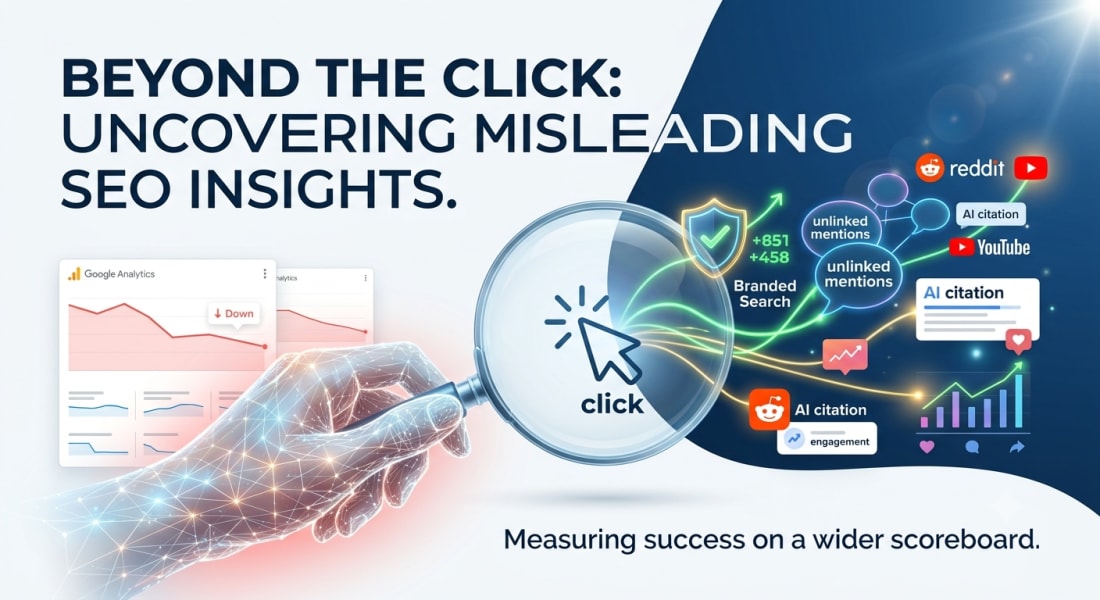
Traffic report misleading insights are becoming more common in modern SEO, leaving many business owners wondering why their SEO traffic is dropping.. I had a call last month with a client who runs a small D2C skincare brand. She was staring at her Google Analytics dashboard, visibly frustrated, and said something I’ve heard a dozen times this year: “Our rankings haven’t dropped. Our content is still good. So why does it feel like nobody’s finding us anymore?”
I didn’t have a tidy answer for her on the spot. But the more I sat with it, the more I realized she wasn’t wrong to feel that way — and she also wasn’t looking at the right number.
Key Takeaways
- A shrinking share of searches actually send a click to the open web — much of that attention now lives inside Google itself or on platforms like Reddit and YouTube.
- Generic, “anyone could’ve written it” content is losing the most ground to AI-generated answers.
- Branded search and unlinked mentions are becoming stronger signals of real influence than raw session counts.
- Measuring success now means tracking a wider scoreboard: sessions, branded queries, citations, and mentions — together, not separately.
The Click Was Never the Whole Story, But We Treated It Like One
For years, “did they click?” was basically the only question that mattered in content and SEO. You wrote the piece, it ranked, someone clicked, and that click showed up neatly in a spreadsheet as proof your work mattered. Simple, if a little too simple.
That model is falling apart, and not because content stopped working. It’s because Google stopped being the only place people finish their search. A huge share of queries now get answered right there on the results page — an AI summary, a snippet, a map listing — and the person never has a reason to leave. They got what they needed. Your website just wasn’t part of the transaction, even if your content quietly shaped the answer they saw.
That’s the uncomfortable part. Your work can be doing something and still show up as nothing in the report.
So Where Did Everybody Go? (The AI Search Impact on SEO)
This is why a traffic report misleading businesses into thinking SEO is failing can create the wrong picture of performance.Not nowhere. That’s the important bit. Attention didn’t evaporate, it moved to places that are harder to track with a UTM tag.
A lot of it is still sitting inside Google itself — AI-generated overviews, business listings, map results. Reddit threads are showing up in search results more than they used to, and honestly, people trust a messy, opinionated forum thread more than a polished landing page half the time. There’s something almost old-fashioned about that — we’re back to trusting word of mouth, it’s just word of mouth with a search bar in front of it. Search Engine Journal has been tracking this shift closely, and it’s a good habit to check in on their coverage every so often.
Then there’s video and social, especially with younger audiences who never really started their research on a traditional website in the first place. YouTube, TikTok, Instagram — these aren’t “extra” channels anymore. For a lot of people, they’re the front door.
And the content that’s getting hurt the worst? Generic explainer posts. The kind of “what is X” or “top 10 Y” articles that could have been written by literally anyone about literally any brand. If an AI can answer it in two sentences without needing your specific experience, it will, and it won’t send anyone your way to check.
What Actually Still Pulls a Click

I’ll be honest, not everything is bleeding traffic. Transactional searches (“buy,” “near me,” “pricing”) are still landing on real websites because people need to complete an action, not just absorb information. Branded searches too — once someone knows your name, they go find you directly.
Which is the real shift here: brand awareness is starting to matter more than keyword rankings. This lines up with the idea of brand equity — the value a name carries on its own, independent of any single transaction. If someone sees your name mentioned three times on a Reddit thread, once in a YouTube comparison video, and once when they ask an AI chatbot for a recommendation, they’ll eventually just search your brand name directly and land on your site. Your analytics will call that “direct traffic,” with zero indication that the actual work happened somewhere else entirely, days earlier.
I came across this exact idea explained well in this guide on ranking in Google AI results, where the team breaks down how AI-powered search has changed what “ranking” even means — it’s less about a blue link on page one now and more about whether your brand gets cited and mentioned at all, anywhere your audience is paying attention. It’s worth a read if you want the agency-side view of this shift, since BizzBuzz Creations works with clients navigating exactly this kind of reporting headache every day.
Zero Click Searches: How Do You Measure Something You Can’t Click?
This is the part nobody has fully figured out, myself included. But a few things are worth tracking even if they’re messier than a sessions graph.
Branded search volume is one of the clearest signals you have. If people are typing your company name into Google more often, something is working upstream, even if you can’t point to which piece of content did it. Google Search Console will show you this filtered by branded queries — it’s not perfect, but it’s a start.
Unlinked mentions matter more than they used to. Someone talking about your product on Reddit without linking to you still counts for something, especially if an AI tool later pulls that thread into an answer. There isn’t a clean dashboard for this yet, so a lot of teams are just doing manual searches for their brand name and logging what comes up.
And honestly, just paying attention to where you’re being cited by AI tools themselves is becoming its own small discipline. It feels a bit like being your own reputation manager.
Ready to Get Found Beyond the Click?
Partner with our digital marketing experts to build strategies that grow your brand visibility, earn you mentions across the web, and turn AI-driven search into real business results.
The Real Adjustment Isn’t Technical, It’s Emotional
Here’s what I keep coming back to. A lot of the anxiety around this shift isn’t really about traffic — it’s about proof. Clicks felt like proof that the work mattered. Losing that certainty is uncomfortable, even when the underlying strategy is still sound.
My advice to that skincare client, and to pretty much anyone asking the same question, is to stop chasing the old scoreboard and start building a wider one. Keep an eye on sessions, sure, but put branded search, mention tracking, and social engagement right next to it. None of those numbers alone tells the full story. Together, they at least give you an honest picture instead of a comforting but incomplete one.
The click isn’t dead. It’s just no longer the only receipt you’re going to get.
Written by
Khushi Gupta