
Jul 31, 2026 · Khushi Gupta
How to Grow Organic Traffic from 0 to 10K in 2026
SEO Growth Framework · 2026 From zero to a steady 10,000 organic visitors This actionable guide is brought to you by BizzBuzz Creations to help you…

 ShreyaAdvisor
·12 min read
Want this done for you? See our SEO services or talk to us.
If your website traffic is dropping in 2026 — or simply not growing despite consistent effort — the real problem might not be your keywords, your content frequency, or even your backlinks.
It could be trust.
Google’s EEAT in SEO — Experience, Expertise, Authoritativeness, and Trustworthiness — is now the single most important framework separating websites that rank consistently from websites that quietly disappear after every core update.
After Google’s Helpful Content Update, the March 2026 Core Update, and a series of spam-focused algorithm changes, one thing is crystal clear: Google is no longer just reading your content. It is evaluating your credibility, your identity, and your real-world reputation.
Websites that lack strong SEO trust factors are losing rankings — not because of technical errors, but because Google simply doesn’t trust them enough to recommend them to its users.
So before we talk about keywords, backlinks, or any other tactic — ask yourself this one question:
Does Google trust your website enough to rank it?
Let’s break it down — completely, practically, and honestly.
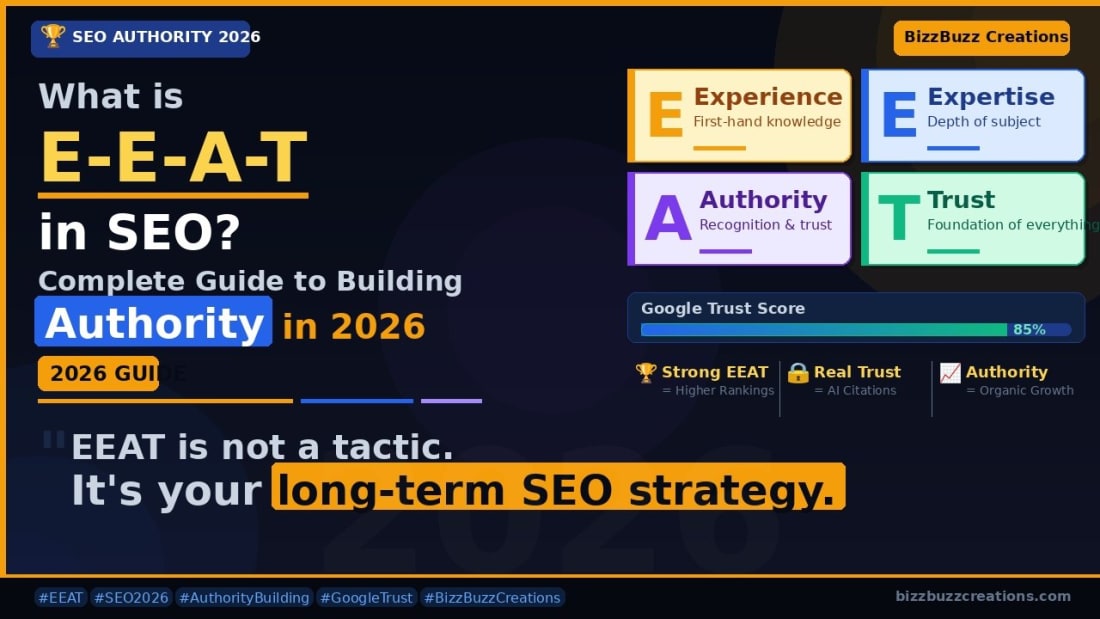
E-E-A-T stands for Experience, Expertise, Authoritativeness, and Trustworthiness.
It is the core framework described in Google’s Search Quality Rater Guidelines — a document used by Google’s human quality raters to evaluate whether a webpage genuinely deserves to rank for a given query.
Originally introduced as E-A-T, Google added the extra “E” for Experience in December 2022 — a significant shift that signalled Google now cares not just about what you know, but whether you’ve actually done it.
In simple terms:
EEAT = The reason Google should trust you over your competitors.
It applies to every type of website — blogs, business websites, e-commerce stores, local business listings, and everything in between.
Let’s be direct about what happened in 2026.
Google’s March 2026 Core Update and the preceding Helpful Content Update together formed the most aggressive trust-based algorithm shift in recent years. They were specifically designed to:
What is ranking now, post-update?
If your website lacks these signals, it doesn’t matter how many keywords you target or how frequently you publish. Rankings will drop — and they will stay down until the trust gap is fixed.
The addition of “Experience” to Google’s quality framework was a direct response to one growing problem: too much content was being written by people who had never actually done the thing they were writing about.
Google now actively distinguishes between content created by someone with genuine first-hand experience versus content assembled from research alone.
What experience looks like in practice:
How to demonstrate Experience on your website:
Expertise is about how deeply you understand your subject. Surface-level content — the kind that covers a topic broadly without going deep — is exactly what Google’s quality rater guidelines flag as low-quality.
For YMYL websites (Your Money or Your Life — covering health, finance, legal, or safety topics) — formal credentials and professional qualifications are essential. For other niches, demonstrated expertise through content quality, accuracy, and depth carries the most weight.
How to demonstrate Expertise:
Pro Tip: If you run a local coaching institute, your expertise content should cover not just general exam tips, but specific preparation strategies, subject-level breakdowns, and result analysis based on your own students’ performance.
Authority is the one EEAT factor you cannot give yourself. It is earned when others — credible others — recognize, reference, and recommend your work.
Google’s Quality Rater Guidelines describe authoritativeness as your reputation within your industry or niche. This is measured through:
How to build Authoritativeness:
See our guide on building a local SEO backlink strategy for Prayagraj businesses
According to Google’s own documentation, Trustworthiness is the most important of the four EEAT factors. You can have experience, expertise, and authority — but if users don’t trust your website, every other signal is weakened.
Core SEO trust factors Google evaluates:
The hard truth: A website that publishes brilliant content anonymously, with no contact page, no reviews, and inconsistent business information — is a website Google cannot trust. And a website Google cannot trust will not rank.
Here are specific, practical steps — not generic advice:
1. Build a compelling “About Us” page. Include real team photos, individual bios with credentials, your company story, specific achievements, and client outcomes. This is the most underinvested page on most websites and one of the most important trust signals Google evaluates.
2. Add named author bios to every piece of content. Every blog post should carry a named author with a linked bio page showing their expertise, experience, and credentials. This single change can dramatically strengthen your EEAT signals.
3. Publish original data and research. Even a small survey of 30–50 customers or an analysis of your own campaign results creates original, citable content. Original data builds authority faster than almost any other strategy.
4. Build a consistent review strategy. Ask satisfied customers to leave detailed, specific Google reviews. Vague reviews like “Great service!” carry less weight than detailed ones describing specific experiences and outcomes.
5. Fix your NAP consistency immediately. Your business Name, Address, and Phone number must be identical across your website, Google Business Profile, social media profiles, and every directory listing. Inconsistencies are one of the most damaging local trust signals Google monitors.
6. Build topical authority through content clusters. Instead of publishing disconnected articles, build interconnected content around your core expertise areas. A digital marketing agency should have a hub page on “Digital Marketing Strategy” surrounded by supporting articles on SEO, Google Ads, Social Media, and Lead Generation — all internally linked.
7. Optimize your structured data. Use Schema markup — Article Schema, LocalBusiness Schema, FAQ Schema, and Review Schema — to help Google understand your content, your business, and your credibility signals in machine-readable format.
8. Audit and update old content quarterly. Outdated articles with old statistics, broken links, or superseded information actively harm your EEAT. A quarterly content audit keeps your trust signals current and signals to Google that your website is actively maintained.
If you run a local business — a coaching institute, a clinic, a restaurant, a digital agency — local EEAT is one of the most powerful and underutilized ranking opportunities available to you.
Local EEAT signals that Google evaluates:
Real example: A coaching institute in Civil Lines, Prayagraj that publishes content like “Best NEET Preparation Strategy for Class 11th Students in Prayagraj” — combined with 50+ genuine Google reviews and consistent local citations — will outrank a competitor with better general SEO but weaker local trust signals every single time.
Read our complete Google Business Profile optimization guide
This is the question every content creator and business owner is asking — and the honest answer requires some nuance.
AI-generated content is not automatically penalized by Google. The Google Helpful Content Update made this clear. What IS penalized is content that is:
The right way to use AI while maintaining strong EEAT:
Use AI as a research assistant and drafting tool — not as a replacement for human expertise. The winning formula in 2026 is:
AI structure + Human experience + Original insight + Named author = High-EEAT content
Write with AI assistance, then layer in your personal experience, real case studies, updated data, and genuine opinions. Always publish under a named human author who takes accountability for the content.
The content that ranks in 2026 reads like it was written by a knowledgeable human who used smart tools — not generated by a machine imitating human thought.
These are the reasons most websites are struggling to rank in 2026:
Here is my honest assessment of where search is heading — and I’m willing to stand behind it.
SEO in 2026 is no longer only about ranking in the traditional blue links. It’s about becoming the trusted source that feeds Google’s AI Overviews, voice search answers, and featured snippets.
This is AEO optimization — Answer Engine Optimization — and EEAT is the non-negotiable foundation it is built on.
Google’s AI will only extract and present answers from sources it trusts. If your EEAT is weak, your content will not be selected for AI Overviews — regardless of how well it ranks organically. If your EEAT is strong, you can dominate not just page one rankings but the AI-generated answer panels that now appear above everything else.
The businesses and websites investing seriously in Google EEAT guidelines today are building the most defensible long-term SEO asset possible — one that algorithm updates will consistently reward rather than punish.
The websites ignoring EEAT — chasing keywords, buying links, and publishing generic AI content — are building on sand.
A: E-E-A-T stands for Experience, Expertise, Authoritativeness, and Trustworthiness — Google’s framework for evaluating whether a webpage is credible and helpful enough to rank. After Google’s 2026 updates, it is the most critical long-term ranking foundation for any website.
A: Add named author bios with credentials, publish original case studies, earn genuine customer reviews, fix NAP consistency, build quality backlinks, and create topical authority through interconnected content clusters.
A: EEAT is not a direct ranking signal, but it heavily influences Google’s quality evaluation systems. Websites with strong EEAT rank higher, recover faster from core updates, and sustain long-term visibility.
A: Google’s original E-A-T covered Expertise, Authoritativeness, and Trustworthiness. In December 2022, Google added “Experience” — recognizing that real first-hand knowledge carries more weight than theoretical expertise alone.
A: Google’s March 2026 Core Update heavily penalized anonymous, thin, and AI-only content — while rewarding websites with strong trust signals, verified authors, and genuine topical authority.
A: YMYL (Your Money or Your Life) covers health, finance, and legal topics. Google applies the strictest EEAT standards to these niches — making verified credentials and professional expertise non-negotiable for ranking.
BizzBuzz Creations is a digital marketing and business solutions agency in Prayagraj, India. Here is where we can help with what you just read.
Not sure which one you need? Get a free consultation.
Suggested for you
Jul 31, 2026 · Khushi Gupta
SEO Growth Framework · 2026 From zero to a steady 10,000 organic visitors This actionable guide is brought to you by BizzBuzz Creations to help you…
Oct 13, 2025 · Mohd Ahsan
Table of Contents Google SEO Algorithm Updates: Everything You Need to Know in 2025 In the fast-changing world of digital marketing, one thing…
Sep 17, 2025 · Satyam Gupta
Learn how fresh website backlinks can help your site rank higher, bring more visitors, and grow your online presence fast.