Google Ads vs Meta Ads: Which Platform Generates Better ROI in 2026?
Published on
Introduction: The Question Every Business Owner Asks
You have a marketing budget.
It’s not unlimited. Every rupee matters.
And someone — a friend, a consultant, a YouTube video — told you to “run ads.” But now you’re staring at two platforms, two dashboards, and one very real question:
Google Ads or Meta Ads — where should I actually put my money?
I’ve managed campaigns across both platforms for businesses in Prayagraj and across India — from local coaching institutes to e-commerce brands to B2B service companies. And I’ll tell you the honest truth upfront:
There is no universal answer. But there is a right answer for YOUR business.
This guide will help you find it.
By the time you finish reading, you’ll know exactly which platform suits your business goals, your audience, and your budget — and how to get the best ROI from either or both in 2026.
Let’s break it down.
What’s Changed in 2026: The New Paid Ads Landscape
Before we compare platforms, you need to understand how drastically the paid advertising landscape has shifted.
Three things changed everything in 2026:
1. AI-driven automation took over. Both Google and Meta have moved heavily into AI-automated campaigns. Google’s Performance Max and Meta’s Advantage+ now make most bidding, placement, and creative decisions automatically — leaving advertisers with less manual control but potentially better results if set up correctly.
2. Privacy changes killed traditional targeting. iOS updates, cookie deprecation, and tightening data regulations have significantly reduced the precision of interest-based targeting. Both platforms have adapted — but Meta felt the impact harder.
3. User behavior fragmented. People are now discovering products on Instagram Reels, researching on Google, watching YouTube reviews, and converting on WhatsApp. The linear funnel is dead. Both platforms now play different roles in a more complex buyer journey.
Understanding this context is critical — because it changes how you evaluate ROI on each platform.
Google Ads vs Meta Ads: The Core Difference
Before numbers and comparisons — understand this fundamental distinction:
Google Ads captures existing demand. Meta Ads creates new demand.
This single insight should drive your entire paid strategy.
Google Ads works because people are actively searching for what you offer. They type “NEET coaching in Prayagraj” or “digital marketing agency near me” — they already want something. Your ad meets them at the moment of intent.
Meta Ads (Facebook + Instagram) works because you can interrupt people with something they didn’t know they needed — but will want once they see it. You’re planting a seed. Building awareness. Creating desire.
Neither approach is better. They’re different tools for different jobs.
Google Ads in 2026: Strengths, Weaknesses & ROI
What Google Ads Does Best
High-intent lead generation. When someone searches for your exact service, they’re already in buying mode. A plumber searching for “emergency plumber Kanpur” is ready to call. A student’s parent searching “NEET coaching Prayagraj” is ready to inquire. Google puts your business right in front of them.
Search + Performance Max combination. In 2026, the winning Google Ads setup combines traditional Search campaigns (for high-intent keywords) with Performance Max campaigns (for broad reach across YouTube, Gmail, Display, and Maps). Together, they cover the full funnel.
Local business visibility. Google’s Local Services Ads and Maps integration make it the single most powerful platform for local businesses wanting to capture nearby customers actively looking for their services.
Measurable, trackable conversions. Google Ads integrates directly with Google Analytics 4, making it significantly easier to track the complete journey from ad click to conversion to revenue.
Google Ads Weaknesses in 2026
- Higher cost per click in competitive industries. For keywords like “insurance,” “loans,” or “MBA courses,” CPCs can reach ₹200–₹500+ per click — making it expensive for businesses with tight margins.
- Limited audience building. Google is strong at capturing demand but weak at building brand awareness among cold audiences who don’t know you exist yet.
- Learning curve. Performance Max campaigns require significant data before they optimize well. New accounts need patience and budget to build momentum.
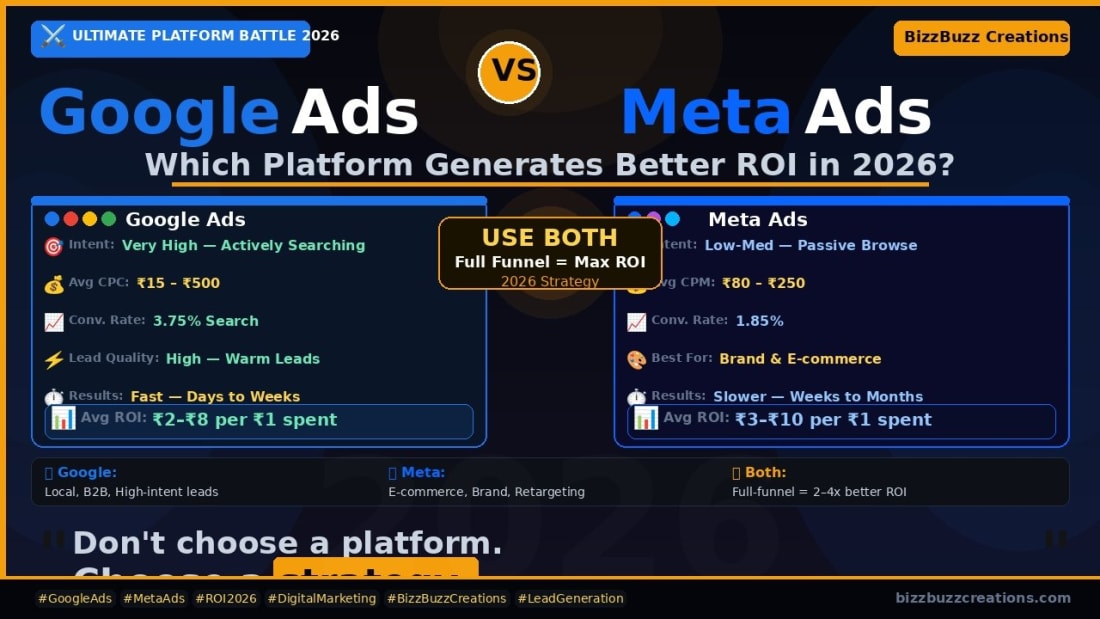
Google Ads Average ROI in 2026
According to industry benchmarks:
- Average ROI: ₹2–₹8 return for every ₹1 spent (varies heavily by industry)
- Best performing industries: Legal, medical, education, home services, B2B
- Average CPC India: ₹15–₹80 (general); ₹80–₹500 (competitive niches)
- Average conversion rate: 3.75% (search); 0.77% (display)
Meta Ads in 2026: Strengths, Weaknesses & ROI
What Meta Ads Does Best
Audience targeting at scale. Despite privacy changes, Meta still has the richest behavioral and demographic data of any social platform. You can target parents of Class 11 students in Prayagraj who have shown interest in competitive exams. That specificity is still unmatched.
Visual storytelling and brand building. Instagram Reels, Facebook video ads, and carousel formats let you tell your brand’s story in ways text-based Google search ads simply cannot. For businesses where trust and emotional connection matter — coaching institutes, healthcare, fashion, food — Meta’s visual formats create powerful impressions.
Retargeting precision. Meta’s retargeting capabilities remain among the strongest in digital advertising. Showing ads specifically to people who visited your website, watched 75% of your video, or added to cart but didn’t purchase — is still highly effective in 2026.
Lower entry cost. For most industries, Meta Ads allow businesses to start seeing results with smaller budgets — making it accessible for startups and small businesses testing their first campaigns.
Advantage+ Shopping and Lead Gen. Meta’s AI-powered Advantage+ campaigns have significantly improved lead quality for e-commerce and service businesses in 2026 — especially when combined with strong creative.
Meta Ads Weaknesses in 2026
- Lower purchase intent. People on Instagram aren’t looking to buy — they’re scrolling for entertainment. Converting cold audiences requires more touchpoints, more creative, and more patience.
- Creative fatigue is real. Meta audiences burn through ad creatives faster than any other platform. What works today may stop working in 2 weeks. Constant creative refresh is non-negotiable.
- Attribution challenges. With iOS privacy changes, Meta’s ability to accurately track conversions has reduced. Many conversions happen but aren’t properly attributed — making ROI measurement harder.
- Rising CPMs. As more businesses pour money into Meta, competition for attention has driven up costs. Average CPM (cost per 1000 impressions) in India has risen 40% over the past two years.
Meta Ads Average ROI in 2026
- Average ROI: ₹3–₹10 return for every ₹1 spent (e-commerce performs best)
- Best performing industries: E-commerce, fashion, food & beverage, coaching/education, real estate
- Average CPM India: ₹80–₹250
- Average CTR: 0.90% (feed); 1.84% (stories/reels)
- Average conversion rate: 1.85%
Head-to-Head Comparison: Google Ads vs Meta Ads
| Factor | Google Ads | Meta Ads |
|---|---|---|
| User Intent | High — actively searching | Low–Medium — passive browsing |
| Best For | Lead generation, local services, B2B | Brand awareness, e-commerce, retargeting |
| Audience Targeting | Keyword + demographic | Behavioral + interest + lookalike |
| Average CPC (India) | ₹15 – ₹500 | ₹8 – ₹60 |
| Average CPM (India) | ₹100 – ₹400 | ₹80 – ₹250 |
| Conversion Rate | 3.75% (Search) | 1.85% |
| Brand Building | Weak | Very Strong |
| Lead Quality | Higher (warm leads) | Medium (cold to warm) |
| Time to Results | Faster (days–weeks) | Slower (weeks–months) |
| Creative Requirement | Low (text-based) | High (visual/video) |
| Budget Entry Point | ₹500–₹1000/day minimum | ₹200–₹500/day minimum |
| Analytics & Tracking | Excellent (GA4 integration) | Moderate (post-iOS) |
| AI Automation | Performance Max | Advantage+ |
| Best Campaign Type | Search + PMax | Reels + Retargeting |
Which Platform is Better for Lead Generation?
This is the most asked question — and here’s the honest breakdown:
For Local Service Businesses (Coaching, Clinic, Agency, Restaurant)
Winner: Google Ads — by a clear margin.
When a parent in Prayagraj searches “best NEET coaching near me” — they’re ready to call. Google Search puts you right in front of that intent. The lead quality is significantly higher because the prospect already wants what you offer.
Recommended setup:
- Search campaigns targeting high-intent keywords
- Google Local Services Ads for map visibility
- Retargeting via Display for people who visited but didn’t convert
For E-commerce Brands
Winner: Meta Ads + Google Shopping combined.
Meta drives discovery — people find your product while scrolling. Google Shopping captures them when they search to buy. Using both creates a full-funnel system that significantly outperforms either alone.
For B2B Businesses
Winner: Google Ads for search; LinkedIn for social.
Meta’s B2B targeting has improved but still lags. For businesses targeting decision-makers — CFOs, marketing managers, business owners — Google Search captures active buyers while LinkedIn targets by job title and company.
For Brand Awareness and New Product Launches
Winner: Meta Ads — especially Instagram Reels.
Nothing builds brand recognition faster than a well-crafted Reels campaign reaching a targeted audience consistently. For new businesses or new product launches, Meta’s visual storytelling formats create the emotional connection that drives future conversions.
The Real Answer: Use Both — But Strategically
Here’s what I tell every client who asks me this question:
Google Ads captures the demand that already exists. Meta Ads builds the demand that will exist.
The highest-ROI businesses in 2026 don’t choose one over the other. They use a Full-Funnel Strategy:
Stage 1 — Awareness (Meta): Instagram Reels and Facebook video ads introduce your brand to cold audiences. Budget: 30% of total.
Stage 2 — Consideration (Meta Retargeting + Google Display): Follow up with website visitors and video viewers. Show testimonials, case studies, offers. Budget: 20% of total.
Stage 3 — Conversion (Google Search): Capture high-intent searches from people who have seen your brand before or are actively looking. Budget: 40% of total.
Stage 4 — Retention (Meta + Email): Retarget existing customers with new offers, upsells, or referral incentives. Budget: 10% of total.
This compound strategy consistently outperforms single-platform approaches by 2–4x in our client campaigns.
[ Read our complete Google Ads setup guide for local businesses]
Real Example: A Coaching Institute in Prayagraj
Let me make this concrete with a real scenario.
Business: NEET/JEE coaching institute, Civil Lines, Prayagraj Budget: ₹15,000/month Goal: Quality admissions inquiries
Google Ads (₹9,000/month):
- Target keywords: “NEET coaching Prayagraj,” “JEE classes near me,” “best coaching Class 11 Prayagraj”
- Average CPC: ₹45
- Estimated clicks: 200/month
- Conversion rate: 8% (high because intent is strong)
- Estimated leads: 16 per month
Meta Ads (₹6,000/month):
- Target: Parents aged 32-50, Prayagraj + 25km, interest in education/competitive exams
- Instagram Reels showing faculty, student testimonials, classroom environment
- Average CPM: ₹120
- Retargeting website visitors
- Estimated leads: 22 per month (lower quality, need nurturing)
Combined result: 38 inquiries/month from ₹15,000 spend = ₹394 per lead
Running either platform alone at ₹15,000 would yield significantly fewer and lower-quality leads.
Common Mistakes That Kill ROI on Both Platforms
On Google Ads:
- ❌ Running broad match keywords without negative keywords — budget drains on irrelevant searches
- ❌ Sending traffic to homepage instead of a dedicated landing page
- ❌ Ignoring Quality Score — poor landing page experience inflates CPC
- ❌ No conversion tracking — flying blind on what’s working
- ❌ Pausing campaigns too early — Google’s AI needs 2-4 weeks of data to optimize
On Meta Ads:
- ❌ Using the same creative for more than 3 weeks — audience burns out
- ❌ Targeting too broadly or too narrowly — both extremes hurt performance
- ❌ No retargeting setup — missing the warmest audience available
- ❌ Ignoring video — static images now significantly underperform Reels
- ❌ Weak landing pages — Meta can drive traffic but can’t fix a page that doesn’t convert.
Frequently Asked Questions
Q: Which is better for ROI — Google Ads or Meta Ads in 2026?
A: It depends on your business type. Google Ads delivers better ROI for high-intent services like local businesses, B2B, and professional services where people actively search. Meta Ads delivers better ROI for e-commerce, brand building, and visual products. For maximum ROI, a combined full-funnel strategy using both platforms consistently outperforms either alone.
Q: Which platform is better for lead generation?
A: Google Ads typically generates higher-quality leads because users are actively searching for your service. However, Meta Ads can generate higher volume at lower cost — though leads require more nurturing. For local service businesses, Google Ads leads convert at significantly higher rates.
Q: How much should I spend on Google Ads vs Meta Ads?
A: A recommended starting split is 60% Google Ads and 40% Meta Ads for service businesses. For e-commerce, a 40/60 split favouring Meta often performs better. Always start with a minimum of ₹300-500 per day per platform to give algorithms enough data to optimize.
Q: Which platform has lower cost per lead in India?
A: Meta Ads typically has a lower cost per lead in India — averaging ₹150–₹400 depending on industry — compared to Google Ads at ₹300–₹800. However, Google leads tend to convert into paying customers at higher rates, making cost per acquisition often comparable or better on Google.
Q: Is Google Ads or Meta Ads better for small businesses?
A: For small businesses with limited budgets, Meta Ads allows entry at lower daily budgets (₹200-300/day) and builds brand awareness effectively. Google Ads requires slightly higher minimum budgets for competitive keywords but delivers faster, higher-intent results. Start with Meta to build awareness, then add Google Ads once you have budget.
Q: What is the average ROI of Google Ads vs Facebook Ads in 2026?
A: Google Ads delivers an average ROI of ₹2–₹8 per ₹1 spent across industries, with higher returns in professional services. Meta Ads delivers ₹3–₹10 per ₹1 spent, with strongest performance in e-commerce. Combined campaigns routinely deliver 30-40% better overall ROI than single-platform approaches.
Conclusion: Stop Asking Which Is Better — Start Asking Which Is Right for You
The Google Ads vs Meta Ads debate misses the point entirely.
Both platforms are extraordinarily powerful — when used correctly, for the right goals, with the right creative, targeting the right audience.
The question was never “which is better.” The question is: “Which is right for my business right now?”
If you’re a local service business wanting immediate high-intent leads — start with Google.
If you’re building a new brand and need awareness and discovery — start with Meta.
If you have a reasonable budget and want maximum ROI — use both, strategically, as a full-funnel system.
The businesses investing in both platforms with a clear strategy are not just running ads — they’re building a scalable growth engine that generates leads around the clock.
And that’s the difference between spending on marketing and investing in growth.
[ Read our complete guide to building a digital marketing growth engine]
Not sure which platform is right for your business? Contact BizzBuzz Creations — We’ll audit your business goals, recommend the right platform mix, and build a paid ads strategy that actually delivers ROI.
📞 081155 85285 | Civil Lines, Prayagraj
Written by
Shreya