
E-E-A-T Explained: How to Build Trust & Authority in 2026
Published on
Introduction: The Rules of SEO Just Changed — Again
Let me ask you something direct.
When was the last time you updated your website’s “About” page? When did you last add a real author bio to your blog? When did your business last earn a genuine mention from another trusted website?
If you’re drawing a blank — Google noticed too.
After the Google March 2026 Core Update, hundreds of thousands of websites lost rankings overnight. Not because of technical errors. Not because of bad backlinks. But because Google decided they simply weren’t trustworthy enough to represent its users.
This is where E-E-A-T in SEO becomes the most important concept you need to understand right now.
In this guide, I’m going to break down exactly what EEAT means, why it matters more than ever in 2026, and — most importantly — what you can do today to start building genuine trust and authority for your website.
What is E-E-A-T? (The Simple Explanation)
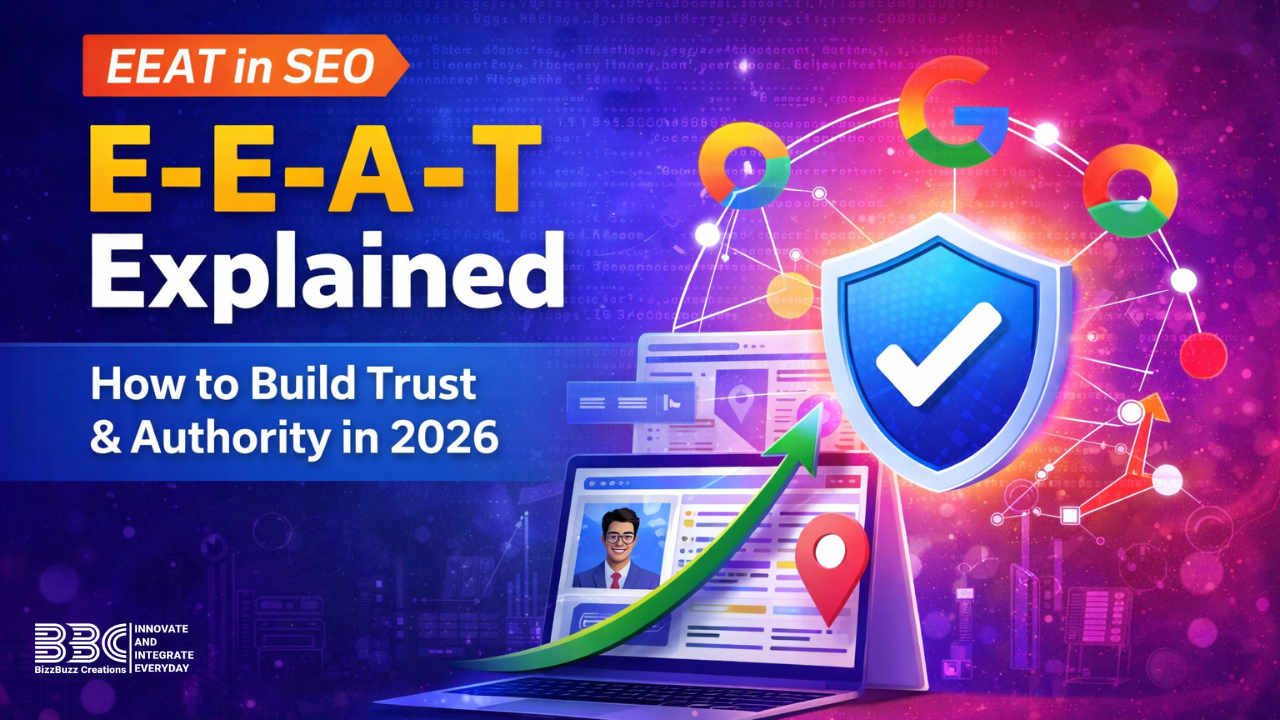
E-E-A-T stands for Experience, Expertise, Authoritativeness, and Trustworthiness.
It’s the framework Google uses — through its human quality raters and AI systems — to evaluate whether a webpage deserves to rank highly for a given search query.
Originally introduced as E-A-T in Google’s Search Quality Rater Guidelines, Google added the extra “E” for Experience in December 2022 — signaling a major shift. Google now rewards content written by people who have lived, practised, or directly experienced what they’re writing about.
Think of it this way:
A blog post about “recovering from a knee injury” written by a physiotherapist who has treated 500 patients carries far more EEAT weight than the same post written by a content agency that researched it for two hours.
That distinction — real experience vs. researched knowledge — is now a core ranking signal in 2026.
Why EEAT Matters More Than Ever After Google’s 2026 Updates
Here’s my honest take: the Google March 2026 Core Update was the most aggressive trust-based update we’ve seen in years.
What it targeted specifically:
- Thin, faceless content — articles with no named author, no credentials, no human voice
- AI-scaled content farms — websites publishing hundreds of AI-generated articles with zero original insight
- Low-trust local businesses — companies with inconsistent NAP data, no reviews, and no credible web presence
- Over-optimized pages — content clearly written for algorithms, not for real humans
What it rewarded:
- Websites with strong author profiles and verifiable credentials
- Content demonstrating real-world experience and first-hand insight
- Businesses with consistent local citations and genuine customer reviews
- Pages structured to directly answer user questions — optimized for both search engines and AI Overviews
The message from Google couldn’t be clearer: be genuinely helpful or become invisible.
The Four EEAT Factors Explained
1. Experience — The Newest and Most Underrated Factor
Experience is Google’s way of asking: “Has this person actually done the thing they’re writing about?”
A travel blogger who has visited 40 countries has experience. A restaurant owner who has run a kitchen for 15 years has experience. A digital marketer who has managed ₹1 crore in Google Ads spend has experience.
How to show Experience on your website:
- Share personal case studies with real numbers and outcomes
- Include photos, behind-the-scenes content, or original data
- Write in first-person where relevant — “In my experience working with local businesses in Prayagraj…”
- Add “last reviewed” or “updated” dates to your content
2. Expertise — Show Google You Actually Know What You’re Talking About
Expertise is about depth of knowledge in your subject area. Google evaluates this differently depending on your niche.
For YMYL topics (Your Money or Your Life — finance, health, legal) — formal credentials matter enormously. For other niches, demonstrated expertise through content quality, detail, and accuracy carries the weight.
How to demonstrate Expertise:
- Create in-depth, well-researched content that goes beyond surface-level advice
- Link to credible external sources — Google Search Central, academic papers, industry reports
- Build topic clusters — a hub page surrounded by deeply relevant supporting articles
- Have content reviewed or contributed to by qualified professionals in your field
3. Authoritativeness — Build Your Reputation Beyond Your Own Website
Authority isn’t something you claim — it’s something others give you.
Google measures authority by looking at who talks about you, links to you, and references you across the web. This is why backlinks still matter — but context matters more than quantity. A single mention in a respected industry publication is worth more than 100 links from low-quality directories.
How to build Authoritativeness:
- Get featured in local news publications, industry blogs, and podcasts
- Earn genuine backlinks through original research, data, or expert opinions
- Build a strong Google Business Profile with consistent information
- Contribute guest articles to high-authority websites in your niche
- Create content others naturally want to cite — original statistics, surveys, tools
See our guide on building a local SEO backlink strategy
4. Trustworthiness — The Foundation Everything Else Is Built On
Google considers Trustworthiness the most important of the four EEAT factors. You can have experience, expertise, and authority — but if users don’t trust your website, none of it matters.
Trust signals that Google looks for:
- Secure website (HTTPS, not HTTP — non-negotiable in 2026)
- Transparent contact information — real address, phone number, email
- Clear privacy policy and terms of service
- Genuine customer reviews on Google, Trustpilot, or industry platforms
- Consistent brand information across all online channels
- No misleading claims, clickbait, or deceptive content
How to Build EEAT for Your Website: 7 Actionable Strategies
Here’s where most EEAT guides get generic. Let me give you specifics.
1. Create a strong “About Us” page. This is the single most underinvested page on most websites. Include real team photos, individual bios with credentials, your company story, and specific achievements. Make it human. Make it verifiable.
2. Add author bios to every piece of content. Every blog post should have a named author with a linked bio page showing their expertise, experience, and credentials. This alone can dramatically improve your EEAT score.
3. Publish original data and research. Even a small survey of 50 customers in your industry creates original, citable content. Original data builds authority faster than almost anything else.
4. Build a consistent review strategy. Ask satisfied customers to leave detailed Google reviews — not just “Great service!” but specific experiences. Detailed reviews signal trust to both Google and potential customers.
5. Fix your NAP consistency. Your business Name, Address, and Phone number must be identical across your website, Google Business Profile, social media, and every directory listing. Inconsistencies destroy local trust signals.
6. Create topic clusters, not isolated articles. Instead of publishing random blog posts, build interconnected content around your core expertise areas. A local business in Prayagraj offering SEO services should have a hub page on “SEO in Prayagraj” surrounded by supporting articles on local keyword research, Google Business Profile optimization, and so on.
7. Audit and update old content regularly. Outdated content — especially articles with old statistics or broken links — actively harms your EEAT. Set a quarterly content audit schedule.
EEAT for Local SEO: Why It Matters Differently for Local Businesses
If you run a local business — a coaching institute, a restaurant, a medical clinic, a digital agency — EEAT works slightly differently for you, and it’s an enormous opportunity.
Local EEAT signals include:
- Google Business Profile completeness — photos, services, Q&A, posts, and a detailed description
- Local citations — consistent listings on JustDial, Sulekha, IndiaMART, and local directories
- Hyperlocal content — blog posts and service pages that mention your city, neighbourhood, and local landmarks
- Local backlinks — mentions in local news, community websites, and regional business associations
- Customer reviews with local context — reviews that mention your location signal local relevance
A business in Civil Lines, Prayagraj that consistently publishes hyperlocal content, earns local citations, and maintains a complete Google Business Profile will outrank a competitor with better general SEO but weaker local trust signals.
EEAT + AI Content: How to Use AI Without Losing Trust
This is the question everyone is asking in 2026 — and the honest answer is nuanced.
AI-generated content is not automatically penalised by Google. What IS penalised is content that is:
- Generic, thin, and adds no original value
- Published at scale without human review or insight
- Lacking any real-world experience or personal perspective
The right way to use AI with EEAT in mind:
Use AI as a research and drafting tool — not as a replacement for human expertise. Write with AI, then layer in your personal experience, original examples, updated data, and genuine opinions. Add a named human author who takes responsibility for the content.
The content Google rewards in 2026 reads like it was written by a knowledgeable human who used smart tools — not generated by a machine trying to imitate a human.
Common EEAT Mistakes to Avoid
 Publishing anonymous content — no author name, no credentials, no accountability
- Copying competitor content with minor rewrites — even paraphrased, duplicate thinking is detectable
- Ignoring your Google Business Profile — especially for local businesses, this is a critical trust anchor
- Buying backlinks — manipulative link schemes now trigger quality penalties faster than ever
- Over-optimizing for keywords while under-investing in genuine helpfulness
- Neglecting mobile and page speed — a slow, poor-experience website signals low trustworthiness regardless of content quality
The Future of SEO: EEAT + AI + AEO
Here’s my opinion — and I’m willing to stand by it.
In 2026 and beyond, SEO is no longer just about ranking in the blue links. It’s about becoming the source that feeds Google’s AI Overviews, voice search results, and featured snippets.
This is Answer Engine Optimization (AEO) — structuring your content to directly answer specific questions in a format Google’s AI can extract and present instantly.
EEAT is the prerequisite for AEO. Google’s AI will only pull answers from sources it trusts. If your EEAT is weak — your content won’t feed the AI. If your EEAT is strong — you can dominate not just traditional rankings but the AI-generated answers that now sit above everything else.
The businesses that invest in genuine EEAT now are building the most defensible SEO asset possible — one that algorithm updates will reward rather than punish.
Written by
Shreya
-Hii, I am SEO specialist skilled in optimizing websites, enhancing online visibility, and driving organic growth through strategic keyword research and content optimization.
Get Free Consultancy Now!
Ready to grow your business with trusted digital marketing services in UP? Contact Bizz Buzz Creations today and let’s build your success story together.