Sep 28, 2026 · KHUSHI GUPTA
Are Reddit and Quora Links Nofollow? How Smart Marketers Still Win
Reddit and Quora links are mostly nofollow, yet they still work. Learn why, how to test any link, and a simple 4-week plan.

11 min read
Most businesses do not have a marketing problem. They have a focus problem. They run a few ads, post on social media, publish a blog now and then, and wonder why nothing adds up. Work without a plan is hard to measure and even harder to repeat.
Our 90-Day Digital Growth Plan fixes that. It gives you a clear order of work, set deliverables for each month, and numbers you can check. This guide shows exactly what happens in each month, what we need from you, and what results are realistic.
It is a structured three-month program that covers the core parts of online marketing: website health, search visibility, content, conversions, and reporting. Instead of doing random tasks, we work in a fixed order. First we find the problems. Then we fix and build. Then we test and improve.
Much of the plan rests on search engine optimization, the practice of improving a website so it appears more often in search results. But the plan goes beyond SEO. It also covers tracking, landing pages, local presence, and paid or social channels when they make sense for your goals.
Think of it as a short sprint with a clear finish line. At day 90, you have a healthier website, working campaigns, real performance data, and a roadmap for what comes next.
The plan fits businesses that want growth but do not have a clear system yet. It works well for:
It is not a good fit if you want instant results or expect a fixed number of leads from day one. Good marketing needs testing, and testing takes time.
Thirty days is too short to see patterns. Search engines need time to crawl, index, and test new pages. A full year is a big commitment for a business that has not worked with an agency before. Ninety days sits in the middle. It is long enough to build and measure, and short enough to stay focused.
| Option | Best For | Main Limit |
|---|---|---|
| One-off task (a single audit or site fix) | A specific, known problem | No testing, no follow-through |
| 90-Day Growth Plan | Building a base and proving what works | Search gains continue after day 90 |
| Long-term retainer | Ongoing growth and scaling | Bigger commitment up front |
If you want the wider picture of how these channels fit together, read our guide on digital marketing in 2026 tips, strategies, and services.
Here is the full 90 days on one page.
| Period | Focus | Main Deliverables | What You Have at the End |
|---|---|---|---|
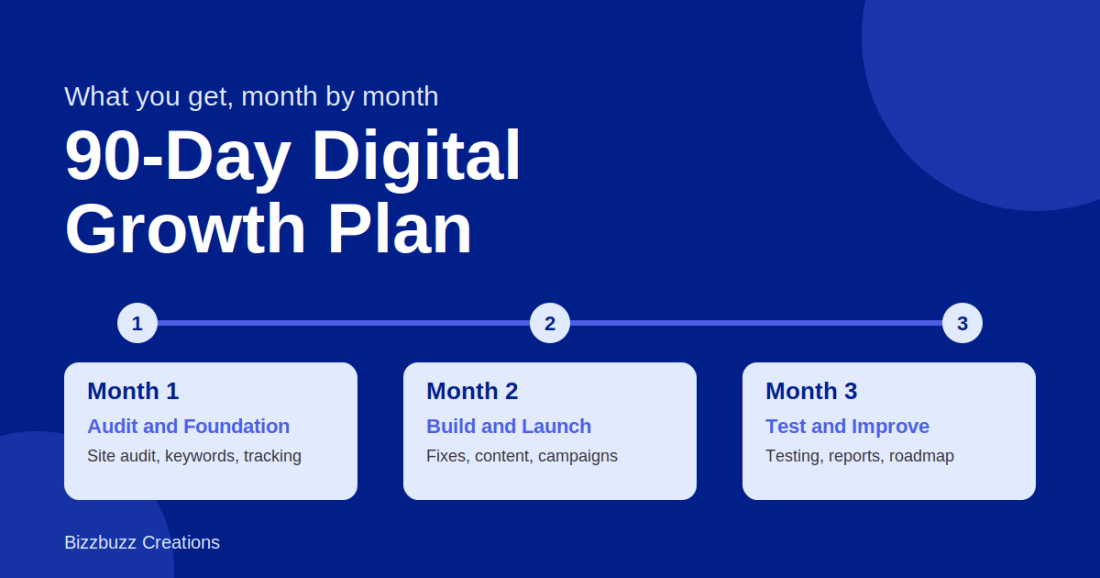
| Month 1 (Days 1 to 30) | Audit and foundation | Site audit, keyword research, competitor review, tracking setup | A clear problem list and a priority plan |
| Month 2 (Days 31 to 60) | Build and launch | Technical fixes, on-page updates, new content, campaign launches | A stronger site and live marketing activity |
| Month 3 (Days 61 to 90) | Test and improve | Conversion tests, link outreach, reporting, next-stage roadmap | Proven data and a plan for the next 6 to 12 months |
Every plan starts with a short onboarding phase. We hold a kickoff call, collect access to your website, analytics, and ad accounts, and agree on goals. A goal like "more traffic" is too vague. We aim for something you can measure, such as "increase contact form submissions" or "grow calls from local search."
We also agree on how often we report, who approves content, and which tools we will use. This avoids delays later.
The first month is about learning. We do not want to publish content or spend ad budget until we know what is working and what is holding you back.
Here is what you get:
At the end of Month 1, you receive a written audit with a priority list. Each issue is ranked by impact and effort, so the biggest wins come first. You also get a simple content plan for Month 2.
This is where most of the visible work happens. We take the priority list from Month 1 and start fixing and building.
We create or update a set of pages and posts based on the keyword research. The number is agreed at the start so there are no surprises. Each piece is written for a real search need, not just to hit a word count.
We also make sure authors, sources, and brand details are clear on the page. Trust matters more every year, and our guide on what E-E-A-T is in SEO and how to build authority explains the thinking behind this step.
By day 60, your site is healthier, your content is live, and campaigns are collecting data.
Now we have real data. Month 3 is about using it.
The final roadmap is yours to keep. You can continue with us, hand it to an in-house team, or use it as a guide for another provider.
Inside every month, the work follows the same loop. This keeps decisions based on data, not guesses.
A key performance indicator is only useful if it connects to a business goal. We keep the list short and tie each number to a decision.
| Metric | Where We Check It | Why It Matters |
|---|---|---|
| Organic impressions and clicks | Google Search Console | Shows if search visibility is growing |
| Keyword positions | Search Console and rank tracker | Shows movement on target terms |
| Conversion rate | Google Analytics | Shows how many visitors take action |
| Leads or sales | Analytics, CRM, or order data | Connects marketing to revenue |
| Page speed and core web vitals | PageSpeed Insights, Search Console | Affects user experience and site health |
| Cost per lead (paid channels) | Ad platform and analytics | Shows if spend is efficient |
This is a made-up example to show the process. It is not a client result and not a promise of specific numbers.
Imagine a local plumbing company with an 18-page website. Calls come in, but nobody knows which ones come from search. The Google Business Profile is half filled out, and mobile pages load slowly.
By day 90, the owner knows where calls come from and what to do next. That clarity is often worth as much as the early traffic gains.
Different channels move at different speeds. Technical fixes and paid campaigns can show signals early. Search growth is slower because pages need time to be crawled, indexed, and trusted. News sites like Search Engine Journal and Search Engine Land often remind readers that SEO is a long game, and we agree.
| Timeframe | What You May See |
|---|---|
| Weeks 1 to 4 | Clean data, a full audit, and a clear action list |
| Weeks 5 to 8 | Faster pages, better titles, early paid campaign data, and new pages being indexed |
| Weeks 9 to 13 | Rising impressions, early keyword movement, and conversion test results |
| After day 90 | Stronger search gains as content matures and authority builds |
Your starting point matters too. A site with deep technical problems may need most of the first 60 days just to get healthy. A site that is already in good shape can move faster.
Good results come from teamwork. To keep the plan on schedule, we ask for a few things:
We have spent more than three years helping businesses with SEO, content, and digital marketing. The same lesson shows up again and again: businesses grow faster when they stop doing everything at once and start doing the right things in the right order.
That is why the plan starts with an audit and ends with a roadmap. We would rather show you a small, solid win and a clear next step than promise something we cannot control. You can learn more about our work on the Bizzbuzz Creations website.
Get a clear audit, a month-by-month action plan, and real data to guide your next steps. Build a stronger digital base in just 90 days.
Ask yourself these questions:
If you answered "no" to the first question and "yes" to the others, this plan is likely a strong fit.
A good growth plan does not need to be complicated. It needs a clear order, honest measurement, and steady follow-through. In 90 days, you move from guessing to knowing. Month 1 shows you what is wrong. Month 2 puts the fixes and new work in place. Month 3 proves what works and points to what comes next.
Whatever you decide, start with data. Know your numbers, fix the biggest problems first, and build from there. That simple habit separates businesses that grow from those that stay stuck.
Suggested for you
Sep 28, 2026 · KHUSHI GUPTA
Reddit and Quora links are mostly nofollow, yet they still work. Learn why, how to test any link, and a simple 4-week plan.
Sep 21, 2026 · KHUSHI GUPTA
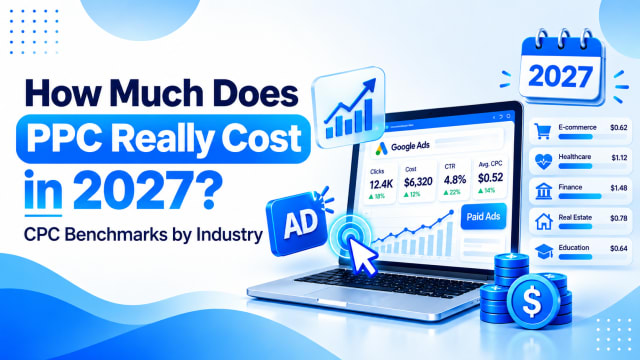
Ask five UK businesses what they pay per click and you'll get five different answers. Here's what PPC really costs in 2027, with CPC benchmarks by…

Aug 17, 2026 · KHUSHI GUPTA
SEO in India can cost anywhere from ₹10,000 to ₹100,000+ per month in 2026. Learn what different SEO packages include, what affects pricing, and…