Digital Marketing in 2026: Tips, Strategies & Services
Published on
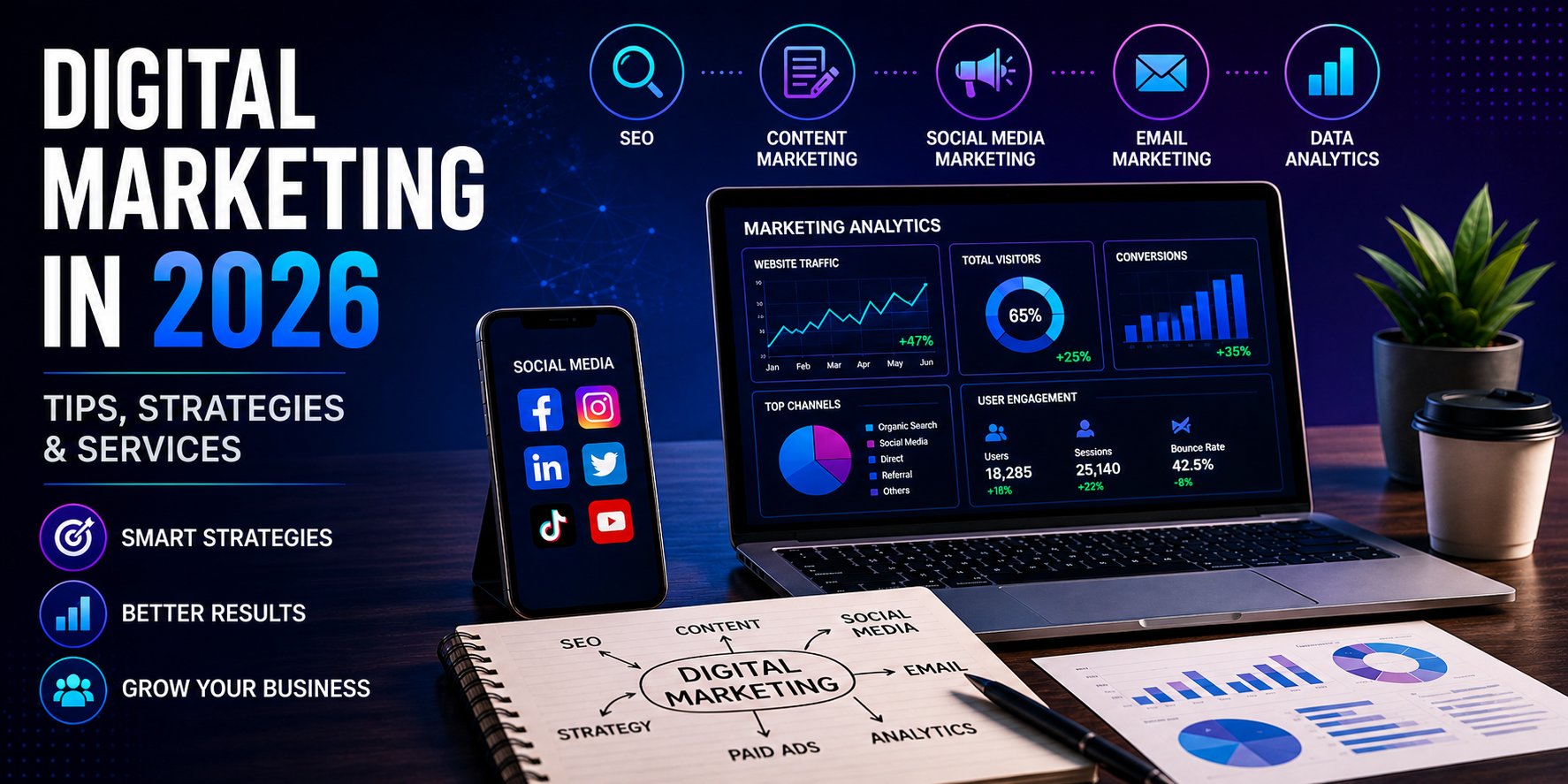
If you've been running the same digital marketing playbook for the last few years, there's a good chance it's quietly losing steam. Search behavior has shifted, AI tools have changed how people find answers, and audiences expect faster, more personalized experiences than ever before. None of this means marketing has gotten harder — it just means the old rulebook needs a rewrite.
This guide breaks down what's actually working right now, whether you're a business owner trying to understand digital marketing for the first time, a founder comparing agencies, or someone simply typing "digital marketing agency near me" into Google at 11pm wondering if it's worth the investment. We'll cover strategy, services, cost expectations, and how to choose the right partner — without the fluff.
Digital marketing has changed significantly. Search behavior, AI-powered discovery, short-form content, personalization and conversion-focused websites are all changing the way businesses attract and convert customers.
What Is Digital Marketing?
Digital marketing is the practice of promoting a business, product, or service using online channels — search engines, social media, email, websites, and paid advertising platforms. Instead of relying purely on traditional advertising like print, TV, or billboards, digital marketing meets customers where they already spend most of their time: online.
At its core, good digital marketing does three things well. It gets your business found by the right people, builds enough trust that they consider buying from you, and makes the path to purchase or enquiry as smooth as possible. Everything else — SEO, social media, ads, content — exists to support those three goals.
Why Digital Marketing Matters More Now
A few years ago, having a website and a Facebook page was often enough to get noticed. That's no longer the case. Buyers now research extensively before making decisions, comparing reviews, checking social proof, and reading content long before they ever speak to a salesperson.
This shift matters for a few practical reasons:
- Search engines have changed how they display results, often answering questions directly, which means visibility depends on more than just ranking position.
- Attention is fragmented across search, social, video, and email, so relying on a single channel is riskier than it used to be.
- Customers expect relevance. Generic messaging gets scrolled past; personalised, useful content gets engagement.
Businesses that treat digital marketing as an ongoing strategy — rather than a one-time project — tend to build more durable visibility over time.
Digital Marketing Strategies: What's Actually Changed
Digital marketing strategies haven't been reinvented from scratch, but the emphasis has shifted noticeably. SEO used to focus heavily on keyword density and backlink volume. Today, it's far more about answering the actual question behind a search, structuring content clearly, and demonstrating real expertise — a shift that aligns closely with Google's own guidance on creating helpful, people-first content .
Paid advertising has moved from broad targeting toward smarter, signal-based targeting, where platforms use behavioural and contextual data to find the right audience rather than marketers manually guessing demographics. Content marketing has shifted from publishing frequently to publishing usefully — fewer, better pieces that actually solve a reader's problem tend to outperform high-volume, low-value content.
2026 Digital Marketing Strategy vs Previous Strategy
Here's a side-by-side look at how the approach to digital marketing has evolved:
| Area | Previous Approach | 2026 Approach |
|---|---|---|
| SEO | Keyword density, exact-match phrases, backlink volume | Search intent, topical depth, structured content, E-E-A-T signals |
| Content Marketing | High volume, generic blog posts | Fewer, higher-quality pieces built around real questions |
| Social Media | Scheduled static posts, broad reach goals | Short-form video, authentic content, community engagement |
| Paid Advertising | Broad demographic targeting | Signal and intent-based targeting, automated bidding |
| Local SEO | Basic directory listings | Optimised Google Business Profile, reviews, local content |
| AI | Rarely used in workflows | AI-assisted research, content drafting, personalisation |
| Search Behaviour | Mostly text search, click-through to websites | Mixed search formats, voice queries, AI-generated answers |
| Analytics | Basic traffic and click tracking | Behaviour tracking, conversion attribution, first-party data |
| Personalisation | One-size-fits-all messaging | Segmented, behaviour-based messaging |
| Conversion Strategy | Focused mainly on traffic volume | Focused on relevance, trust, and reducing friction |
What this means practically: businesses need to stop measuring success purely by traffic numbers and start paying closer attention to relevance, trust signals, and how smoothly a visitor moves toward becoming a customer. Quality and clarity now matter more than sheer volume, across content, ads, and even website design.
10 Practical Digital Marketing Tips
These aren't generic suggestions — they're practical shifts worth actually implementing.
Instead of optimizing a page around "best running shoes," think about what someone actually wants to know — comfort, durability, price range — and answer that directly.
AI tools are great for outlining, summarizing research, or speeding up drafts, but content that sounds robotic or generic tends to underperform. Add real examples and a genuine point of view.
A fully optimized Google Business Profile, consistent business information, and genuine customer reviews often influence local visibility more than people expect.
Replying to comments and messages builds more trust than posting frequency alone.
A 30-second explainer or behind-the-scenes clip often earns more engagement than a polished, overly produced ad.
A well-targeted Google Ads Services campaign can generate faster results while your organic strategy builds momentum in the background.
If your website is slow, confusing, or the contact form is buried, more visitors won't fix the problem — a smoother Web Development Services setup often will.
Understanding where visitors drop off tells you far more than total traffic numbers ever will.
Email lists, customer preferences, and direct feedback are becoming more valuable as third-party tracking becomes less reliable.
Most traffic now arrives on mobile, so slow load times or awkward layouts cost you customers before they even see your offer.
Essential Digital Marketing Services for Businesses
Every business doesn't need every service — but understanding what each one does helps you figure out what actually fits your goals.
SEO
What it does: Improves how easily your website is found on search engines for relevant queries.
Who needs it: Any business that wants consistent, long-term visibility without relying solely on ads.
Problem it solves: Low or inconsistent website traffic and poor search visibility.
Why it matters now: Search results increasingly reward genuinely useful, well-structured content over surface-level optimization. A dedicated SEO services approach helps businesses build that foundation properly.
Local SEO
What it does: Optimizes your online presence for people searching within your specific city or region.
Who needs it: Local shops, clinics, restaurants, and service-based businesses.
Problem it solves: Being invisible to nearby customers actively searching for what you offer.
Why it matters now: More local searches now lead directly to calls, visits, or directions rather than browsing multiple websites first.
Social Media Marketing
What it does: Builds brand presence and engagement across platforms like Instagram, Facebook, and LinkedIn.
Who needs it: Brands wanting to build community, trust, and repeat engagement.
Problem it solves: Weak brand recognition and low customer engagement.
Why it matters now: Short-form content and authentic engagement now drive more visibility than paid reach alone. A structured Social Media Marketing plan keeps this consistent rather than sporadic.
Google Ads / PPC
What it does: Places your business in front of people actively searching for related products or services.
Who needs it: Businesses wanting fast, measurable results alongside organic efforts.
Problem it solves: Slow visibility growth or the need for immediate leads.
Why it matters now: Smarter targeting and automated bidding mean well-managed campaigns can be more cost-efficient than in previous years.
Content Marketing
What it does: Creates blog posts, guides, and resources that answer real customer questions.
Who needs it: Businesses wanting to build authority and long-term organic traffic.
Problem it solves: Lack of trust or expertise signals for potential customers.
Why it matters now: Helpful, well-researched content continues to earn visibility even as search results evolve.
Website Design & Development
What it does: Builds a fast, functional, and visually clear website.
Who needs it: Any business whose website feels outdated, slow, or hard to navigate.
Problem it solves: High bounce rates and lost conversions due to poor user experience.
Why it matters now: A confusing or slow website undermines every other marketing effort pointing traffic toward it.
AI-Powered Marketing
What it does: Uses AI tools for research, personalisation, content support, and campaign optimisation.
Who needs it: Businesses wanting to work more efficiently without sacrificing quality.
Problem it solves: Time-consuming manual processes and generic, one-size-fits-all messaging.
Why it matters now: Used well, AI speeds up workflows while still allowing genuine human insight to shape the final output.
Analytics & Conversion Optimisation
What it does: Tracks how visitors behave on your website and improves the path toward conversion.
Who needs it: Any business investing in traffic that isn't converting into leads or sales.
Problem it solves: Wasted marketing spend and unclear return on investment.
Why it matters now: Understanding behaviour, not just traffic volume, is what actually improves results over time.
How to Choose a Digital Marketing Agency Near Me
Searching for a "local digital marketing agency" or "digital marketing company nearby" usually means you want someone accessible, accountable, and genuinely invested in your results — not just another vendor. Before signing with any agency, it's worth checking a few things:
- Google reviews and reputation — consistent, detailed reviews say more than a high star rating alone.
- Case studies or previous results — ask for real examples relevant to your industry.
- Services offered — make sure they cover what you actually need, not just what they're best at selling.
- Industry experience — a few years in your specific sector can shortcut a lot of trial and error.
- Communication style — you'll be working closely with this team, so responsiveness matters.
- Reporting clarity — you should understand what's happening with your budget, not just receive a vague monthly summary.
- Pricing transparency — clear, upfront pricing avoids awkward surprises later.
- SEO expertise and website quality — an agency whose own website ranks poorly or loads slowly is a fair warning sign.
- Understanding of your local market — whether that's a neighborhood, city, or region, local nuance matters.
Whether you're looking for a digital marketing agency in your area or open to working remotely with a team elsewhere, the fundamentals above still apply.
Digital Marketing for Businesses in India
Digital marketing in India comes with its own dynamics. Search behaviour varies significantly by region and language, and many customers research in English but communicate in regional languages, which makes content strategy genuinely important rather than optional.
For most Indian businesses, a few things consistently matter:
- Local SEO and Google Business Profile optimisation, especially for businesses relying on nearby foot traffic or regional service areas.
- Regional audience targeting, since customer behaviour in metro cities often differs meaningfully from smaller towns.
- Social media presence, which continues to play a major role in brand discovery and trust-building.
- Competitive, value-driven pricing, since Indian buyers often compare multiple options before committing.
- Support for startups, SMEs, and e-commerce brands, who typically need scalable strategies rather than large upfront budgets.
A well-planned digital marketing agency in India understands these regional nuances rather than applying a generic, one-size-fits-all approach.
Digital Marketing for Worldwide Businesses
International marketing requires a noticeably different approach. What works for a domestic audience often doesn't translate directly to customers in another country, culture, or language.
Businesses targeting international markets typically need:
- International SEO, including proper country and language targeting.
- Multilingual content, adapted rather than directly translated, to sound natural to local readers.
- Country-specific keyword research, since search terms and phrasing vary widely by region.
- Localised landing pages, reflecting local currency, terminology, and cultural expectations.
- International paid advertising, with campaigns structured around each market's specific buying behaviour.
- Ongoing analytics and conversion optimisation, since what converts well in one country may underperform in another.
Businesses operating both locally and internationally often benefit from working with an agency that can genuinely handle both — rather than juggling separate vendors for each region.
Why Choose BizzBuzz Creations?
BizzBuzz Creations works as a full-service digital marketing agency supporting businesses across SEO, social media, paid advertising, website development, and overall digital strategy. Rather than offering a single service in isolation, the team focuses on how these pieces work together — since a great ad campaign sending traffic to a slow website, for example, rarely delivers the results a business is actually looking for.
This approach tends to suit a range of businesses well:
- Local Indian businesses looking for a team that understands regional search behaviour and local SEO.
- Startups and SMEs that need a scalable strategy rather than a rigid, one-size-fits-all package.
- E-commerce brands wanting stronger visibility, conversion rates, and repeat customer engagement.
- Businesses targeting international audiences, who need a strategy that adapts across markets rather than assumes one approach fits all.
- Any business needing support across SEO, social media, paid advertising, or website strategy , without managing multiple disconnected vendors.
Ready to Improve Your Digital Presence?
If you're exploring your options, the Digital Marketing Services page outlines what's available in more detail, and you're always welcome to contact BizzBuzz Creations directly to discuss what might actually make sense for your business.
Final Thoughts
Digital marketing in 2026 rewards businesses that focus on genuine usefulness over shortcuts — clear content, a smooth website experience, and strategies built around how customers actually search and decide. Whether you're just starting to explore digital marketing tips or actively comparing agencies, the fundamentals remain the same: understand your audience, show up where they're looking, and make it easy for them to take the next step.
If you'd like help putting any of this into practice, reaching out for a conversation costs nothing and often clarifies more than another hour of research would.
Frequently Asked Questions
Written by
Khushi Gupta
SEO Executive and Content Writer specializing in keyword research, on-page optimization, and digital strategy.
Get Free Consultancy Now!
Ready to grow your business with trusted digital marketing services in UP? Contact Bizz Buzz Creations today and let’s build your success story together.