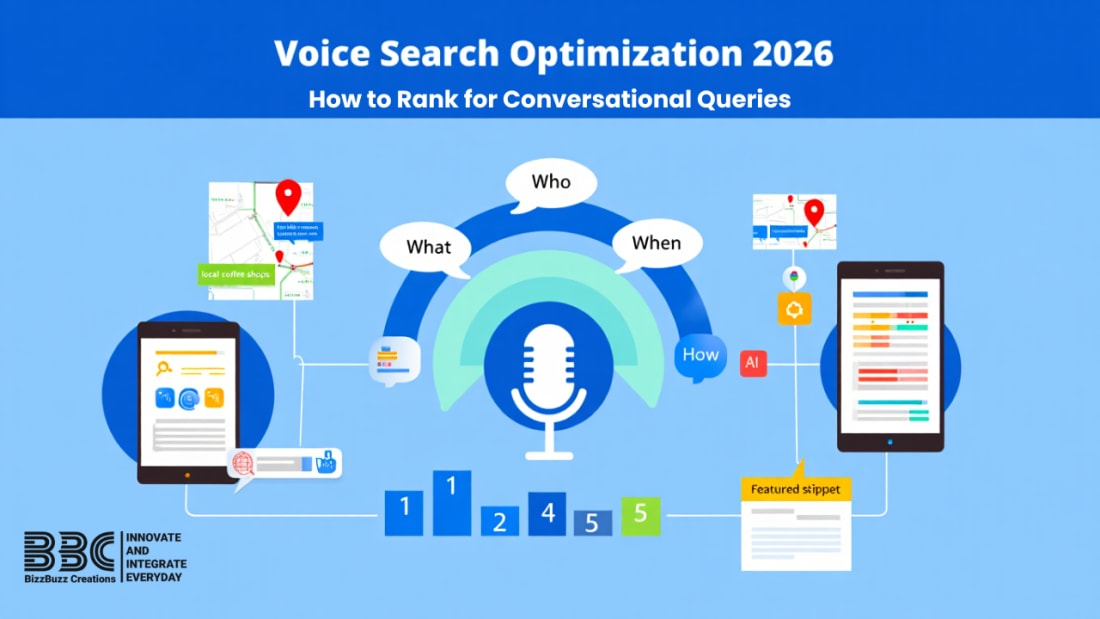
Voice Search Optimization in 2026: How to Rank for Conversational Queries
Search behavior is evolving faster than ever. A few years ago, people mostly typed short keywords into search engines. Today, users are increasingly speaking complete questions to their devices.
Instead of typing something like “voice search SEO”, users now ask:
-
“How can I optimize my website for voice search?”
-
“What is voice search optimization?”
-
“How do businesses rank for conversational queries?”
With the rise of smartphones, smart speakers, and AI assistants, voice search has become a major part of the modern search ecosystem. Businesses that adapt their SEO strategies to this change can capture a large amount of high-intent traffic.
In fact, voice search is becoming one of the key shifts discussed in the future of digital marketing trends. If you want to understand how AI, SEO, and evolving search behavior are reshaping marketing strategies, you can explore our detailed guide on
The Future of Digital Marketing in 2026: AI, SEO, Ads & Conversion Strategy.
What Is Voice Search Optimization?
Voice search optimization is the process of structuring website content so that voice assistants like Google Assistant, Siri, and Alexa can easily understand and deliver it as an answer to spoken queries.
Unlike traditional SEO, which often focuses on short keywords, voice search SEO focuses on natural language queries and conversational intent.
For example:
Typed Search
“voice search SEO”
Voice Query
“How do I rank my website for voice search?”
Search engines now analyze context, intent, and conversational patterns to deliver the most relevant answer.
Why Voice Search Is Growing Rapidly
Voice search adoption is increasing because it is fast, convenient, and hands-free. Users can simply ask their devices for information while driving, cooking, or multitasking.
Several factors are driving this growth:
• Increasing smartphone usage
• Smart speakers and AI assistants
• Faster mobile internet
• Improved AI language processing
As AI continues to evolve, search engines are becoming better at understanding conversational queries rather than just keywords.
How Conversational Queries Work
Voice search queries typically have three unique characteristics.
Natural Language
People speak differently than they type. Voice queries sound more like normal conversations.
Example:
Typed search
“best SEO services price”
Voice search
“How much do SEO services usually cost?”
Question-Based Searches
Most voice searches are questions beginning with:
This is why question-focused content performs well for voice search visibility.
Local Intent
Many voice searches have a strong local intent.
Examples include:
-
“Best coaching institute near me”
-
“Digital marketing agency in Prayagraj”
-
“SEO services near my location”
Because of this, voice search optimization often works best when combined with strong local SEO strategies.
How to Optimize Content for Voice Search
Ranking for conversational queries requires a slightly different approach than traditional SEO. The focus shifts from keyword stuffing to providing clear, structured answers that search engines can easily extract.
One effective strategy is writing content that naturally answers common questions related to your topic.
For instance, if someone asks:
“What is voice search optimization?”
Your content should provide a direct and simple explanation.
Voice search optimization is the process of structuring website content so voice assistants can quickly identify and deliver answers to spoken search queries.
Short and clear explanations like this often appear in featured snippets and voice assistant responses.
Structure Content for Easy Answers
Search engines prefer content that is easy to read and extract information from. Structuring your content properly improves both SEO and voice search visibility.
Helpful practices include:
• Clear headings and subheadings
• Short paragraphs
• Bullet points or numbered lists
• Direct answer sections
When search engines can quickly identify the answer inside your content, the chances of appearing in voice results increase significantly.
Website Speed and Mobile Experience
Voice search users expect immediate answers. If your website loads slowly, search engines may choose another source.
Improving performance helps both SEO and voice search visibility.
Key factors include:
• Fast loading pages
• Mobile-friendly design
• Optimized images
• Strong Core Web Vitals performance
Fast websites provide a better user experience and are more likely to be selected as trusted sources.
Building Authority for AI-Driven Search
Search engines are increasingly focusing on topical authority when selecting sources for answers.
If a website consistently publishes in-depth content around related topics, it signals expertise.
For example, a website that regularly publishes guides about:
is more likely to be considered an authoritative source in the digital marketing space.
The Future of Voice Search SEO
Voice search will continue to grow as AI assistants become more advanced. Search engines are moving toward a future where users receive direct answers rather than just lists of links.
Future trends include:
• conversational AI search
• voice-enabled shopping
• AI generated answers
• deeper intent-based search results
Businesses that start optimizing for conversational queries today will have a strong advantage in the next generation of search.
Final Thoughts
Voice search optimization is not just a temporary trend—it represents a major shift in how people interact with search engines.
Users increasingly expect quick, conversational answers instead of scanning through multiple search results.
Websites that create clear, structured, and user-focused content are far more likely to appear in both traditional search results and voice assistant responses.
By focusing on conversational queries, strong content structure, and topical authority, businesses can stay ahead in the evolving search landscape.
Want to Rank in Voice Search and AI Results?
If you want your website to rank for modern search experiences like voice assistants, AI search, and conversational queries, having the right SEO strategy is essential.
At BizzBuzz Creations, we help businesses build advanced SEO systems that combine:
• AI-driven SEO strategies
• voice search optimization
• high-authority content clusters
• conversion-focused digital marketing
👉 Explore our digital marketing solutions and start building a future-ready search strategy today.