
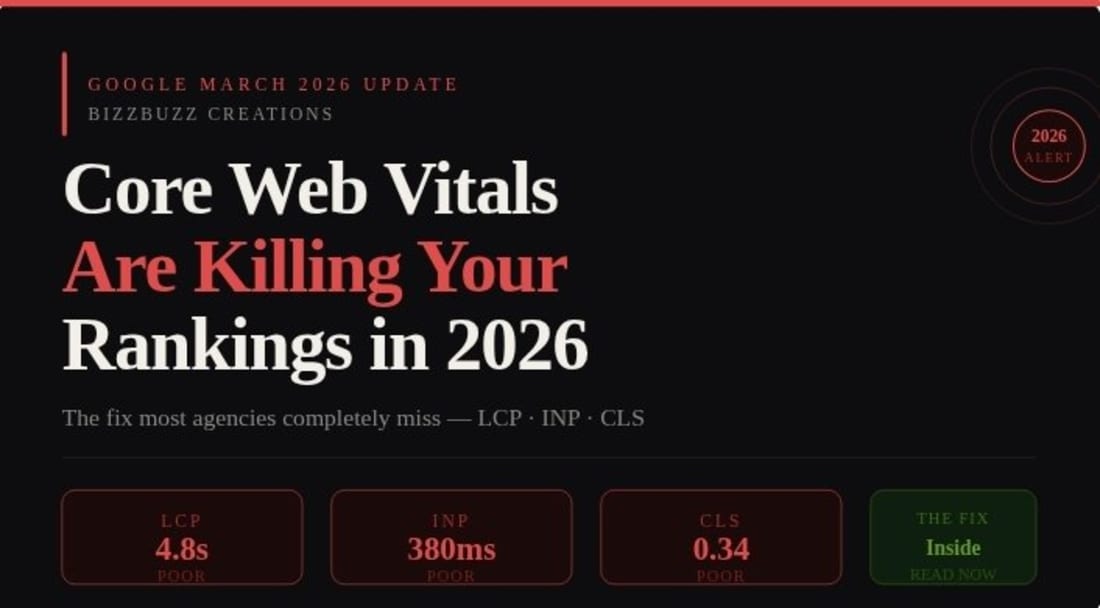
Core Web Vitals Are Killing Your Rankings in 2026 — Here’s the Fix Most Agencies Miss
Published on
Introduction: The Silent Rankings Killer No One’s Talking About
You hired an SEO agency. You’re publishing content regularly. Your backlink profile looks decent.
And yet — your rankings are slipping. Slowly, but noticeably.
Here’s what most agencies won’t tell you: the problem might not be your content at all.
After the Google March 2026 Spam Update, thousands of websites that had “good content” still saw ranking drops. Why? Because Google didn’t just look at what they were publishing — it started caring deeply about how their pages performed.
That’s where Core Web Vitals come in. And most agencies are completely ignoring them.
In this guide, we’re going to break down exactly what Core Web Vitals are, how they interact with Google’s latest 2026 algorithm changes, and the specific fixes that separate businesses that dominate search from the ones that quietly disappear from page one.
What Are Core Web Vitals? (And Why They Matter More Than Ever in 2026)
Core Web Vitals are a set of three performance metrics that Google officially uses as ranking signals. They measure how users experience your page — not just whether your content is relevant.
The three Core Web Vitals are:
1. LCP — Largest Contentful Paint
This measures how fast the biggest visible element on your page loads — usually a hero image or a large heading. Google’s target is under 2.5 seconds.
If your LCP is above 4 seconds, you’re in the “poor” zone, and Google knows your users are likely bouncing before they even read your content.
2. INP — Interaction to Next Paint (Replaced CLS in 2024)
INP measures how quickly your page responds when a user interacts with it — clicks a button, taps a link, opens a menu. The target is under 200 milliseconds.
Poor INP is particularly deadly on mobile, where users expect instant responses.
3. CLS — Cumulative Layout Shift
This measures how much your page jumps around while loading. Ads loading late, images without dimensions, pop-ups that shove content down — all of these damage your CLS score. Google wants it below 0.1.
A bad CLS score creates a frustrating experience where users accidentally click the wrong thing, and it signals to Google that your page is not user-friendly.
The March 2026 Google Update Changed Everything — Including How CWV Are Weighted
The Google March 2026 Spam Update was primarily aimed at low-quality, AI-generated, and manipulative content. But it had a secondary effect that most SEO blogs aren’t covering:
Google tightened the connection between page experience signals and overall ranking ability.
Here’s what the update essentially communicated to the SEO world:
“We don’t just want helpful content. We want helpful content delivered on a fast, frictionless, trustworthy page.”
Before March 2026, you could sometimes compensate for poor Core Web Vitals with strong content and authoritative backlinks. After the update, that buffer is considerably thinner. Websites with strong E-E-A-T signals and good Core Web Vitals are winning. Websites with one but not the other are losing ground.
This means your technical SEO and your content strategy can no longer operate in separate silos. They are the same strategy now.
How Google Uses Core Web Vitals in 2026 Ranking Signals
Let’s be precise here, because a lot of vague claims float around SEO circles:
Google collects real-world performance data through the Chrome User Experience Report (CrUX) — actual data from real users visiting your site. This isn’t your lab data from PageSpeed Insights. This is what your visitors are genuinely experiencing.
The CrUX data feeds directly into Google’s Page Experience signal, which is a ranking factor bundled into the broader ranking system alongside content quality, E-E-A-T, and backlinks.
Post-March 2026, the role of Core Web Vitals within that bundle has become more decisive for one key reason: Google is now much better at filtering out low-quality pages before even evaluating their links and content. A page that fails Core Web Vitals thresholds gets de-prioritized earlier in the evaluation process.
Think of it as a gatekeeper: your page needs to pass the performance check before its content quality gets its full chance to shine.
The Core Web Vitals Mistakes Most Agencies Make (And Charge You For)
Here are the exact issues we see repeatedly when auditing websites that are losing rankings despite having “SEO-optimized content”:
Mistake 1: Optimizing Lab Data Instead of Field Data
Agencies will often show you a PageSpeed Insights score of 90+ and call it a win. But PageSpeed Insights shows both lab data (simulated) and field data (real users). The ranking signal comes from field data, not lab scores.
Your site can score 95 in the lab and still have failing Core Web Vitals in the field — especially if your real users are on slower mobile connections.
The fix: Always check the CrUX dashboard or Google Search Console’s Core Web Vitals report, which shows real-field data segmented by mobile and desktop. That’s the number that matters.
Mistake 2: Ignoring Mobile LCP Completely
Most agencies test desktop performance. Most Google searches happen on mobile. These two facts do not reconcile well, and they’re costing businesses rankings every single day.
Mobile LCP failures are usually caused by:
- Uncompressed hero images not served in WebP or AVIF format
- Render-blocking JavaScript in the
<head> - No lazy loading strategy (or lazy loading applied incorrectly to above-the-fold images)
The fix: Your LCP image should be preloaded with <link rel="preload" as="image">. Your above-the-fold image should never have loading="lazy". These two changes alone can drop mobile LCP by 1–2 seconds.
Mistake 3: Third-Party Scripts Destroying INP
Your CRM widget. Your live chat tool. Your cookie consent banner. Your analytics stack. Every third-party script you load on your site competes for the main thread — the same thread that needs to respond to user interactions.
A bloated main thread means poor INP, and poor INP means Google sees your users having a frustrating experience even when they try to interact with your content.
The fix: Audit every third-party script. Load non-critical scripts with defer or async. Use a Tag Manager strategy that only loads scripts when they’re actually needed. For live chat, consider delay-loading it until after the page is interactive.
Mistake 4: Treating CLS as a “One-Time Fix”
Agencies often fix CLS issues at launch and never look again. But CLS problems creep back. A new ad placement, a new banner, a plugin update that adds dynamic content — any of these can push your CLS back into the red.
The fix: Set up monthly Core Web Vitals monitoring in Google Search Console and connect it to a reporting system you actually check. CLS needs to be treated as an ongoing audit item, not a one-time checkbox.
Mistake 5: Conflating CWV with PageSpeed Score
Core Web Vitals and the PageSpeed performance score are not the same thing. A site with a score of 65 can still pass all three Core Web Vitals thresholds. A site with a score of 88 can still fail LCP.
Agencies selling “PageSpeed optimization” are not automatically selling “Core Web Vitals optimization.” These are different conversations, and you need to make sure your team understands the distinction.
AEO (Answer Engine Optimization): How Core Web Vitals Affect AI Overview Eligibility
Here’s a dimension of Core Web Vitals that almost nobody is talking about in 2026: their relationship to AEO — Answer Engine Optimization for Google’s AI Overviews.
When Google’s AI Overview feature selects sources to cite, it pulls from pages that it considers both highly relevant and technically reliable. Google has indicated that page experience signals — including Core Web Vitals — influence which pages are considered eligible for AI Overview citations.
In other words: a slow page with great content might still get passed over for AI Overviews in favor of a slightly less detailed page that loads fast and feels great to use.
For AEO success in 2026, your pages need to:
- Pass all three Core Web Vitals thresholds on mobile (field data)
- Have a clean, crawlable structure with proper heading hierarchy (H1 → H2 → H3)
- Contain direct, concise answers in the first 100–150 words of each section
- Include FAQ schema markup to increase eligibility for featured snippet and AI Overview selection
If you’ve been working on your content structure for AI Overviews without simultaneously fixing your Core Web Vitals, you’re building on a shaky foundation.
GEO (Generative Engine Optimization): Core Web Vitals in the Age of AI Search
GEO — Generative Engine Optimization — refers to optimizing your content for AI-powered search engines like Perplexity, Google’s Gemini-integrated search, and ChatGPT’s browsing feature.
These AI engines crawl the web in real time. And here’s something worth knowing: when an AI engine crawls your page and encounters slow load times, excessive JavaScript, or layout instability, it can have trouble accurately extracting your content.
A page that takes 6 seconds to become interactive is a page whose content might be partially or incorrectly extracted by an AI crawler. That means your carefully optimized content could be misrepresented or deprioritized in AI-generated answers — not because of poor writing, but because of poor performance.
GEO + Core Web Vitals best practices:
- Ensure your most important content is available in the initial HTML response (not loaded via JavaScript after the fact)
- Use semantic HTML structure that makes content hierarchy crystal clear for AI parsing
- Ensure your server response time (TTFB) is under 800ms — slow servers mean AI crawlers may time out or receive incomplete content
- Use structured data (schema.org markup) to help AI engines understand your content type, author, and publication date
The Practical Core Web Vitals Fix Checklist for 2026
Here’s what you or your SEO agency should be doing right now:
LCP Optimization:
- Compress and convert all images to WebP or AVIF
- Preload the hero image using
<link rel="preload"> - Remove render-blocking CSS and JS from
<head> - Use a fast, reliable hosting provider (look for TTFB under 600ms)
- Implement a CDN for static assets
INP Optimization:
- Audit and reduce third-party scripts
- Break up long JavaScript tasks (anything over 50ms)
- Use
scheduler.yield()for deferring non-critical work - Avoid synchronous XHR calls
- Test specifically on mid-range Android devices — they expose INP issues that powerful desktop machines hide
CLS Optimization:
- Set explicit
widthandheightattributes on all images and video elements - Reserve space for ads and dynamic content with CSS
min-height - Avoid inserting content above existing content after page load
- Load web fonts using
font-display: swap - Test CLS on slow 3G connection simulations to catch issues that fast connections mask
How Internal Linking Supports Core Web Vitals Performance
This connection isn’t discussed enough: your internal linking architecture actually affects Core Web Vitals indirectly, but significantly.
Here’s why: when users land on a page with a clear, logical internal linking structure, they navigate deeper into your site. This increases time-on-site and reduces bounce rates. Google’s field data measurement for Core Web Vitals relies on real user sessions — and users who leave immediately contribute poor interaction data to your CrUX scores.
A well-structured internal linking strategy that guides users to genuinely relevant next steps keeps them engaged longer, which improves the quality of your field data.
For example, if you’re learning about Core Web Vitals and the 2026 algorithm landscape, you should also understand what happened in the Google March 2026 Spam Update — because the two are deeply interconnected. Sites that were already penalized by the spam update also tended to have poor technical performance. The correlation is not coincidental.
Similarly, a strong SEO strategy in 2026 requires thinking about your site’s performance layer just as seriously as your content layer. They are not separate disciplines anymore.
Internal linking best practices post-March 2026:
- Link to related topical content naturally within the body of your article (not just in a “Related Posts” widget at the bottom)
- Use descriptive anchor text that tells both users and Google what the linked page is about — avoid “click here” and “read more”
- Ensure your most important pages are reachable within 2–3 clicks from any page on the site
- Build topic clusters: a pillar page on “SEO in 2026” should link to cluster pages on Core Web Vitals, E-E-A-T, AEO, local SEO, and technical SEO
- Audit broken internal links quarterly — they damage crawlability and user experience simultaneously
What Google’s 2026 Algorithm Actually Rewards
Let’s bring this all together. Based on the March 2026 Spam Update and the ongoing evolution of Google’s ranking systems, here’s what winning in search looks like today:
Technical foundation (Core Web Vitals):
- LCP under 2.5 seconds on mobile (field data)
- INP under 200ms
- CLS under 0.1
- TTFB under 800ms
- Mobile-first indexing compliance
Content quality (E-E-A-T):
- Real expertise demonstrated throughout the content
- Named authors with verifiable credentials
- First-person experience and real-world examples
- No mass AI-generated content without meaningful human editing
Structural optimization (AEO/GEO):
- Direct answers to questions within the first 150 words of each section
- Proper FAQ schema, Article schema, and BreadcrumbList markup
- Clean semantic HTML (H1 → H2 → H3 hierarchy)
- Short, scannable paragraphs with clear topic sentences
Authority signals:
- Topical authority built through content clustering (not random blog posts)
- Genuine brand signals (consistent NAP data, Google Business Profile, social presence)
- Natural backlinks from relevant, trustworthy sources
Frequently Asked Questions About Core Web Vitals in 2026
Are Core Web Vitals a confirmed Google ranking factor?
Yes. Google confirmed Core Web Vitals as part of the Page Experience signal in 2021, and their weight within the ranking system has grown with each algorithm update since. In 2026, they function as both a direct ranking signal and an eligibility filter for features like AI Overviews.
What's the difference between lab data and field data for Core Web Vitals?
Lab data is simulated performance (what PageSpeed Insights calculates). Field data is real-world performance from actual users, collected via CrUX. Only field data contributes to your Google rankings. Always optimize for field data.
Does Core Web Vitals apply to all pages or just the homepage?
All pages. Google evaluates Core Web Vitals at the URL level. A slow product page or blog post can underperform in rankings even if your homepage is perfectly optimized.
How long does it take for Core Web Vitals improvements to affect rankings?
All pages. Google evaluates Core Web Vitals at the URL level. A slow product page or blog post can underperform in rankings even if your homepage is perfectly optimized.
Can I still rank without perfect Core Web Vitals scores?
Yes — Core Web Vitals are one signal among many. But in competitive niches post-March 2026, where content quality is high across the board, Core Web Vitals become the differentiator. Two equally strong pieces of content on comparable sites: the one with better Core Web Vitals wins.
Conclusion: The Fix Most Agencies Miss Is the One You Can’t Ignore
Most SEO agencies are selling you content. Some are selling you links. Very few are selling you the complete picture — and the complete picture in 2026 includes your site’s performance layer as a non-negotiable component of your search visibility.
After the Google March 2026 Spam Update, the message is clear: Google is building a search ecosystem that rewards real value, real trust, and real performance. Core Web Vitals are the technical expression of that standard.
If your LCP is sluggish, your INP is unresponsive, or your CLS is making users click the wrong things — no amount of keyword optimization will fully compensate.
The fix isn’t complicated. But it requires treating your site’s performance and your content strategy as a single, unified discipline rather than two separate checklists.
At BizzBuzz Creations, we audit both layers — technical performance and content strategy — because we know that rankings in 2026 are won at the intersection of the two.
Ready to Fix Your Core Web Vitals and Dominate Google in 2026?
At BizzBuzz Creations, we help businesses:
- Audit and fix Core Web Vitals at the field data level (not just lab scores)
- Build SEO strategies that are fully aligned with Google’s 2026 ranking priorities
- Optimize content for AI Overviews, featured snippets, and generative search
- Recover from Google spam and algorithm update penalties
Book a free SEO audit today — and let’s make sure your site is built to rank, not just to look good in PageSpeed Insights.
Written by
Shreya