
The Psychology Behind Why People Buy Products and Services
Published on
Most people think they buy things because they need them. But if you look closely, the real reasons run deeper than that. People buy based on how they feel, what they believe about themselves, what others around them are doing, and dozens of other invisible mental triggers.
Understanding the psychology of buying is not just an academic exercise. For any business trying to grow, it’s the difference between marketing that works and marketing that wastes budget. At BizzBuzz Creations, we’ve spent over three years working with brands across industries, and one thing we’ve seen consistently is this: businesses that understand why people buy always outperform those that only know what they’re selling.
This article breaks down the core psychological forces that drive consumer behavior. No jargon, no fluff—just what actually happens in a buyer’s mind.
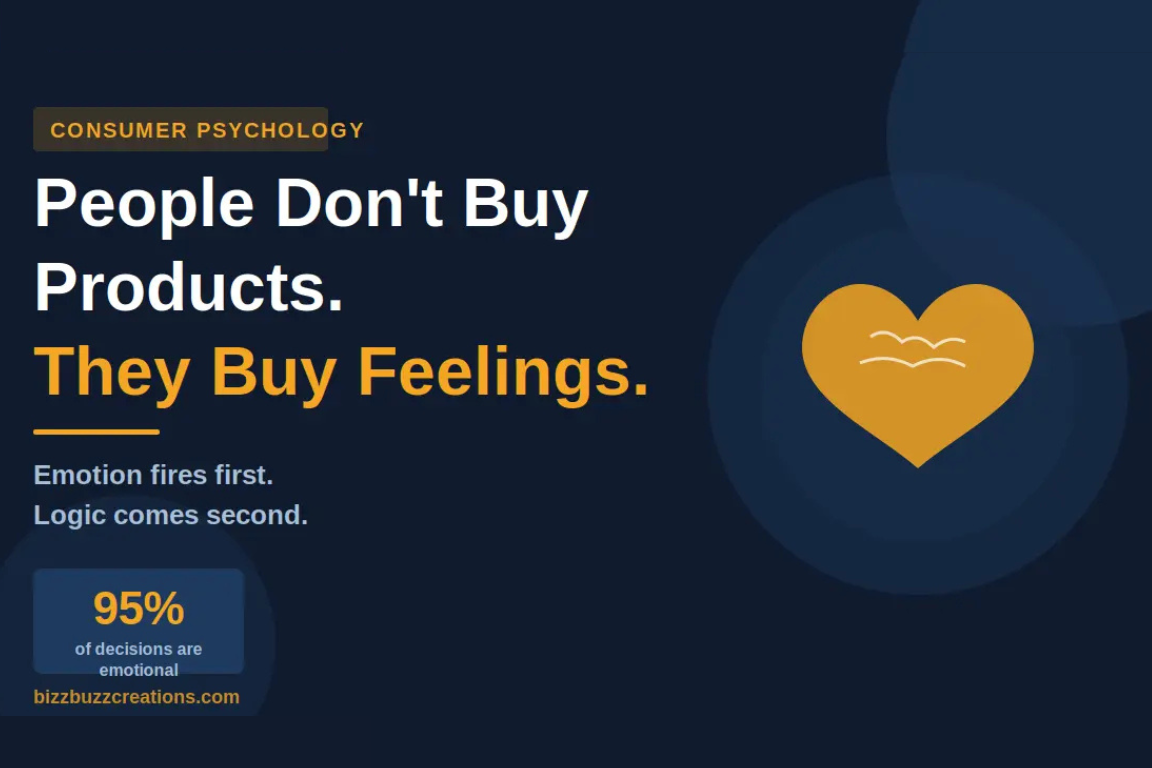
People Don’t Buy Products. They Buy Feelings.
The first thing to understand is that every purchase is an emotional decision justified by logic afterward.
A person doesn’t buy a luxury watch to tell time. They buy the feeling of success it gives them. Someone doesn’t subscribe to a fitness app because they’ve carefully analyzed all options—they subscribe because they felt motivated after watching a transformation video.
Research in consumer neuroscience consistently shows that emotional responses in the brain fire before rational thought kicks in. The logic comes second—it’s used to explain a decision already made emotionally.
The Role of Perceived Value vs. Actual Value
Buyers rarely know the “true” value of something. What they know is how valuable something feels.
This is why two bottles of water—one generic, one branded—can sell at wildly different prices. The product is nearly identical. The perceived value is not.
Perceived value is shaped by:
- Brand reputation — a well-known name automatically commands more trust
- Presentation and packaging — cheap packaging signals cheap product, regardless of what’s inside
- Social proof — if thousands of people use it, it must be worth it
- Price itself — higher price often signals higher quality in the buyer’s mind (Veblen goods are a well-documented example of this)
A business that only competes on price is fighting the hardest possible battle. Businesses that build perceived value win on trust.
The Six Principles of Influence (Cialdini’s Framework)

Robert Cialdini’s work on influence is arguably the most referenced framework in consumer psychology. His six principles explain most of what drives people to say yes.
| Principle | What It Means | Example |
|---|---|---|
| Reciprocity | People feel obligated to give back when they receive something | A free guide that leads to a paid course |
| Commitment & Consistency | Once people commit to something small, they’re more likely to continue | A free trial that converts to a subscription |
| Social Proof | People follow what others are doing | Star ratings, testimonials, “bestseller” labels |
| Authority | People trust experts and credentials | Case studies, certifications, media mentions |
| Liking | People buy from those they like or relate to | Brand personality, relatable founders, tone of voice |
| Scarcity | Limited availability increases desire | “Only 3 left in stock”, countdown timers |
These principles aren’t tricks. They reflect how human decision-making actually works. When used honestly, they help buyers make decisions with more confidence.
Loss Aversion: Fear of Losing Matters More Than Hope of Gaining

Here’s something that surprises most people. Humans are more motivated to avoid loss than to achieve gain. This is called loss aversion, and it was documented extensively by psychologists Daniel Kahneman and Amos Tversky.
The math is roughly this: losing $100 feels about twice as painful as gaining $100 feels good.
In buying behavior, this shows up as:
- Fear of missing out (FOMO) on a deal
- Urgency driven by expiring offers
- Anxiety about making the wrong choice
- Buyers holding back purchases because the risk of a bad experience outweighs the potential benefit
Good marketing addresses fear of loss directly. It reduces risk through guarantees, free returns, trial periods, and honest reviews. When the perceived risk of buying drops, the conversion rate goes up.
Social Identity and the “Who Am I?” Purchase
A significant portion of what people buy is tied to identity—how they see themselves and how they want others to see them.
This isn’t vanity. It’s deeply human. Social identity theory tells us that people define themselves partly through the groups they belong to, and purchases are one way of signaling that membership.
Someone who buys organic food isn’t just buying food—they’re buying into an identity around health, environment, and values. Someone buying a specific brand of sneakers is buying social belonging with a group they admire.
Identity-driven purchases are sticky. Once a product becomes part of how someone sees themselves, they’re far less likely to switch brands, even for a better price elsewhere.
For businesses, this means the goal isn’t just to sell a product—it’s to become part of a customer’s identity. That’s done through consistent brand values, community building, and the kind of storytelling that lets buyers see themselves in your brand.
The Pain-Point Purchase: Solving a Real Problem
Not every purchase is emotional or identity-driven. Some are purely about solving a problem, and the more painful that problem is, the stronger the motivation to buy.
This is the most straightforward form of purchase psychology: person has a problem → product or service offers the solution → person buys.
But even here, psychology plays a role. The same problem can feel more or less urgent depending on:
- How recently the person experienced the pain
- Whether they believe a solution is actually possible
- How clearly the solution is communicated
Businesses that sell solutions should spend less time talking about their product and more time describing the problem in terms the buyer immediately recognizes. When a potential buyer reads something and thinks “that’s exactly what I’m dealing with,” they’re already halfway to buying.
The Decision Fatigue Problem
The more choices someone faces, the harder it becomes to decide—and the more likely they are to walk away without buying anything at all.
Barry Schwartz’s “Paradox of Choice” explains this well. Too many options create anxiety instead of freedom. People become afraid of making the wrong choice, so they make no choice.
This is why the best-converting product pages and service offers are often the simplest ones. They narrow options, guide the buyer toward one clear decision, and reduce the mental work required.
Practical takeaway for businesses:
| Too Many Choices | Optimized for Decision |
|---|---|
| 12 pricing plans | 3 clearly differentiated plans |
| 50+ product variants | Curated bestsellers with a clear recommendation |
| No clear CTA | One prominent call-to-action per page |
| Overloaded product page | Clean layout with hierarchy |
When you reduce decision fatigue, you remove friction from the buying process.
Trust: The One Thing That Overrides Almost Everything Else

None of the other psychological levers work without trust. A buyer might want a product, feel the urgency, relate to the brand’s identity—but if they don’t trust the business, they won’t buy.
Trust is built through:
Consistency — Your brand shows up the same way every time. Your website, your content, your customer service all feel like the same entity.
Transparency — You’re honest about what you offer, what it costs, and what happens if something goes wrong.
Social proof — Real reviews, real case studies, real people who have bought and benefited.
Expertise signals — Content that demonstrates deep knowledge, not surface-level information.
In digital marketing, trust is also heavily influenced by how your brand appears online. A business with strong Google reviews, a well-maintained website, and active industry presence feels more credible than one without. We’ve written more about how digital presence affects buyer trust in our piece on why your digital marketing agency might not be delivering results.
The Anchoring Effect: How First Numbers Shape All Decisions
Anchoring is a cognitive bias where the first number or piece of information someone sees becomes a reference point for everything that follows.
This is why:
- A product marked down from $199 to $99 feels like a bargain, even if $99 was always the real price
- Showing a premium plan first makes the standard plan look reasonably priced
- A consulting firm mentioning a $50,000 project early in a conversation makes a $10,000 proposal seem modest
The first number sets the frame. Everything afterward is judged relative to it.
This isn’t manipulation—it’s how the brain naturally works with comparisons. Understanding anchoring helps businesses structure their pricing, proposals, and offers in ways that feel fair and attractive to buyers.
Habit and Comfort: Why People Keep Buying What They Know
A large percentage of purchases are not made consciously at all. They’re habits—automatic behaviors that repeat because they once worked and never got replaced.
This is great news for businesses that have already earned a customer’s loyalty. The default behavior is to keep buying from you. Breaking that habit is hard for competitors.
It’s harder news for new businesses trying to displace existing habits. To get someone to switch, you have to do more than be slightly better—you have to make the switch feel easy and the benefit feel obvious.
This is why onboarding experiences matter so much. The first few interactions a new customer has with your product or service set the behavioral patterns that either stick or don’t.
Emotional vs. Rational Decision-Making in Different Product Categories
Not all purchases are equally emotional or rational. The balance shifts depending on the product type.
| Product/Service Type | Primary Driver | Secondary Driver |
|---|---|---|
| Luxury goods (watches, cars) | Emotion / Identity | Rational justification |
| Software / SaaS tools | Rational need | Social proof |
| Impulse items (snacks, accessories) | Emotion / Habit | Price |
| Healthcare / Insurance | Fear / Loss aversion | Authority / Trust |
| Professional services (agency, legal) | Trust / Authority | Rational evaluation |
| Fashion and personal care | Identity | Emotion |
| B2B purchases | Rational evaluation | Risk aversion |
Understanding where your product sits in this matrix helps you know which psychological levers to pull harder.
How Digital Behavior Amplifies These Triggers
In today’s environment, most purchase psychology plays out online before a buyer ever contacts a business or walks into a store. Search, social media, reviews, and content all shape how a buyer feels about a brand before any direct interaction happens.
This means:
- Search intent matters deeply — what a person searches for reveals the exact psychological state they’re in (problem-aware, solution-aware, or ready to buy)
- Content builds trust and authority — consistently helpful content signals expertise before a sale ever happens
- Reviews and social proof are the new word of mouth — most buyers check reviews before buying; not having them is worse than having mixed ones
- Speed and experience reduce friction — a slow or confusing website triggers loss aversion; the cost of a bad experience feels too high, so buyers leave
If you’re working to improve how buyers find and evaluate you online, understanding how to rank in Google’s AI results is increasingly important. And with more buyers using voice search to research purchases, optimizing for conversational queries is becoming a meaningful part of reaching buyers at the right moment.
A Note on GEO and AEO: Matching Buyer Psychology to Search Behavior
Buyers ask questions before they buy. They type those questions into Google, speak them into their phones, and expect useful, clear answers.
Generative Engine Optimization (GEO) and Answer Engine Optimization (AEO) are about making sure your business shows up as the answer to those questions. The psychology here is straightforward: the business that answers the buyer’s question first is the one that earns the most trust, and often the sale.
If you want to understand how these two approaches differ and why they both matter for reaching buyers where they are, our breakdown of GEO vs AEO is a useful starting point.
What This Means for Your Business
Understanding buyer psychology doesn’t require a degree in behavioral economics. It requires asking better questions about your customer.
Instead of: “What features should we highlight?”
Ask: “What does this customer fear, and how do we reduce that fear?”
Instead of: “How do we get more traffic?”
Ask: “What does a buyer need to feel before they trust us enough to buy?”
Instead of: “Why aren’t people converting?”
Ask: “Where in the psychological journey are we losing them?”
The businesses that win long-term are the ones that treat buying as a human behavior—shaped by emotion, identity, trust, habit, and social dynamics—and build their marketing accordingly.
Written by
kushmal