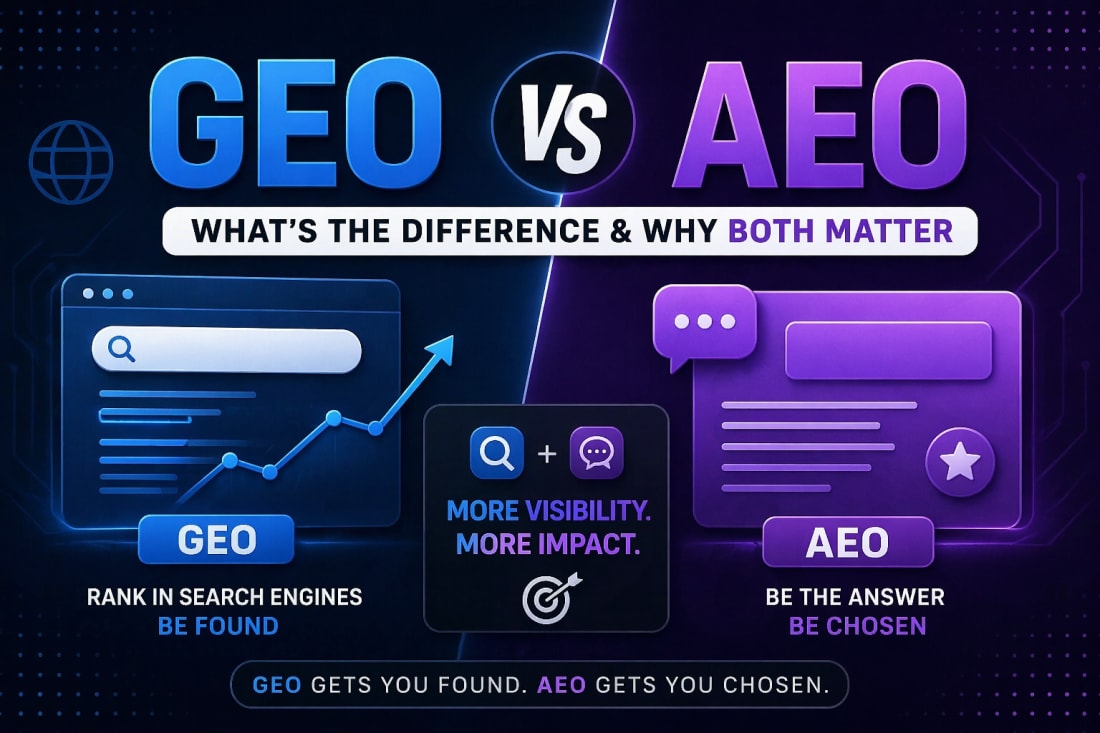
The New Reality of AI-Powered Search

Not long ago, the digital marketing playbook was simple: rank on Google, get clicks, convert visitors. But 2024 changed everything — and 2026 is making it even more urgent.

Think about the last time you needed an answer to something. Did you type a keyword into Google and scroll through ten blue links? Or did you ask ChatGPT? Use Google’s AI Overview? Talk to Siri or Alexa? Search on Perplexity and get a direct, cited answer without clicking a single website?

That’s the new search reality — and most businesses are still operating like it’s 2019. They’re optimizing for one engine, one behavior pattern, and one type of visibility. In 2026, that’s a losing strategy.

Today, staying found online requires a three-layered approach: Traditional SEO, Answer Engine Optimization (AEO), and Generative Engine Optimization (GEO). Understanding each one — and how they work together — is what separates brands that grow from brands that disappear.

36% of searches now show AI Overviews
1B+ ChatGPT active users worldwide
58% users prefer direct answers over links
🔗
Related Read — BizzBuzz Creations
Zero-Click Searches & Google AI Overviews: How to Capture Visibility in 2026
bizzbuzzcreations.com › blog › zero-click-searches →

What is SEO? (And Why It’s Still Non-Negotiable)

Search Engine Optimization (SEO) is the practice of optimizing your website and content to rank higher on traditional search engines — primarily Google and Bing. You’re still optimizing for humans who type a query, see a list of results, and click through to your website.

SEO has three core pillars that remain just as relevant in 2026:

  • On-page SEO — Keyword research, title tags, meta descriptions, header structure, content quality, internal linking, and readability. This is what signals Google’s crawlers about what your page is about.
  • Technical SEO — Site speed, Core Web Vitals (LCP, CLS, INP), mobile-friendliness, crawlability, schema markup, and structured data. The infrastructure that lets Google actually index your content.
  • Off-page SEO — Backlinks from authoritative domains, brand authority signals, and E-E-A-T: Experience, Expertise, Authoritativeness, and Trustworthiness. Google’s quality scorecard for your brand.

Key point: SEO is not dead. Google processes over 8.5 billion searches per day. If you abandon your SEO foundation chasing newer trends, you’ll bleed your biggest source of organic traffic. Build on it — don’t replace it.

That said, SEO alone is no longer sufficient. Google’s AI Overviews now answer many queries above the organic results — sometimes without sending a single click to any website. Zero-click searches now represent a significant and growing percentage of all search activity. That’s exactly where AEO and GEO become critical.

What is AEO? Answer Engine Optimization Explained

“People don’t want ten links anymore. They want one right answer, delivered instantly.” — That’s the core premise behind Answer Engine Optimization.

AEO (Answer Engine Optimization) is the practice of structuring your content to be selected as the direct answer by search engines, voice assistants, and AI-powered answer interfaces. Unlike SEO where success means earning a click, AEO success means your content becomes the answer — often without the user ever visiting your site.

The “answer engines” AEO targets include:

  • Google’s Featured Snippets — the “position zero” box above organic results
  • Google’s AI Overviews (formerly Search Generative Experience / SGE)
  • People Also Ask (PAA) boxes that expand throughout Google’s results
  • Voice assistants — Siri, Alexa, Google Assistant — which read one answer aloud
  • Bing’s AI-powered sidebar and integrated Copilot responses

How to Optimize for AEO in 2026

AEO is built on a deceptively simple principle: write content that directly, concisely, and clearly answers the questions your audience is actually asking. Here’s the actionable checklist:

AEO Optimization Checklist — 2026
01
Use question-based H2/H3 headings. Format headings as actual questions: “What is AEO?”, “How does Answer Engine Optimization work?”, “Why is AEO important for small businesses?” Google lifts these directly into featured snippets.
02
Write concise 40–60 word answer paragraphs. Lead each section with a direct, self-contained answer. The ideal featured snippet response is tight — then you can expand with supporting detail beneath it.
03
Implement structured data / schema markup. FAQ schema, HowTo schema, and Article schema tell Google your content is organized and answer-ready. Use Google’s Rich Results Test to verify your markup.
04
Target long-tail, conversational queries. Voice searches are naturally conversational: “What’s the best way to improve my website’s SEO for free?” — not just “improve SEO.” Match this in your content’s question-answer format.
05
Add FAQ sections to every key page. FAQ sections are gold for AEO — they directly match the “People Also Ask” format Google prioritizes. Every product page, service page, and blog post should have one.

AEO in real life: A user says to Alexa, “Which CRM is best for small businesses?” Alexa reads one answer out loud — not ten. If your content is structured to clearly answer that question, your brand gets spoken into people’s living rooms. No click required. That brand exposure compounds over time.

📖
Deep Dive — BizzBuzz Creations
Zero-Click Searches & Google AI Overviews: How to Capture Visibility in 2026 — a complete breakdown of how to win position zero
bizzbuzzcreations.com › blog › zero-click-searches →

What is GEO? Generative Engine Optimization Explained

GEO is newer, broader, and arguably the most important digital marketing frontier of this decade. Generative Engine Optimization (GEO) is the practice of optimizing your brand, content, and online presence so that AI language models — ChatGPT, Gemini, Perplexity, Claude, Copilot — reference, cite, or recommend your brand when generating responses.

Unlike SEO (which drives users to click through to your site) or AEO (which earns you a direct answer slot in Google), GEO ensures that when AI synthesizes a response from across the web, your brand, data, or expertise is part of what gets said.

The core difference: GEO is about becoming a source that AI trusts, cites, and recommends — not just a URL that ranks on a results page. It’s brand visibility in the AI layer of the internet.

Why GEO Is Fundamentally Different

When someone asks ChatGPT, “What’s the best project management tool for a remote team of 20 people?”, the AI doesn’t return ten links. It synthesizes information from its training data and web browsing — and delivers a confident, conversational recommendation. If your brand is present in high-authority reviews, forums, industry publications, and structured content, you have a much higher chance of appearing in that answer.

GEO requires thinking about visibility not just in terms of “what does Google’s algorithm reward” but “what does a large language model consider credible, authoritative, and worth citing?”

🚀
Complete Guide — BizzBuzz Creations
Generative Engine Optimization (GEO): How to Rank in AI-Generated Results — our full deep-dive guide
bizzbuzzcreations.com › blog › generative-engine-optimization-geo →
GEO Optimization Checklist — 2026
01
Build brand authority through high-quality citations. Get your brand mentioned in Wikipedia, Trustpilot, G2, industry association publications, Forbes, TechCrunch, and other sources that AI models treat as authoritative ground truth.
02
Publish original data and research. When AI tools look for statistics, they pull from original studies, surveys, and benchmark reports — and they may credit your brand as the source. Annual reports and data studies are GEO gold.
03
Write clear, structured, factual prose. AI models process content that is well-organized, precise, and free of filler. Use bullet points, define terms explicitly, back every claim with data or sources.
04
Ensure consistent brand presence across the web. ChatGPT and Perplexity synthesize from multiple signals: Reddit threads, Quora answers, review sites, directories, press coverage, and social platforms. Be consistently present and positively represented across all of them.
05
Optimize for AI crawlers (Perplexity, ChatGPT browsing). These tools actively crawl live web pages. Ensure your site loads fast, is technically sound, and your most important content is not locked behind JavaScript walls or login screens.

For a complete, step-by-step breakdown of GEO strategy — including how to audit your current AI visibility and build a six-month roadmap — check out our dedicated guide: Generative Engine Optimization: How to Rank in AI-Generated Results.

GEO vs AEO vs SEO: Key Differences at a Glance

SEO

Target: Google/Bing search results pages
Goal: Rank in the top 10 organic links
Success: User clicks through to your site
Metric: Rankings, organic traffic, CTR
User: Active searchers browsing results

AEO

Target: Featured snippets, voice, PAA, AI Overviews
Goal: Be the direct answer at position zero
Success: Brand read aloud / shown without click
Metric: Snippet wins, voice visibility
User: People wanting immediate answers

GEO

Target: ChatGPT, Gemini, Perplexity, Claude
Goal: Be cited in AI-generated responses
Success: Brand recommended by AI
Metric: AI brand mentions, citation frequency
User: AI-first searchers, conversational queries

“The businesses that win the next decade won’t just rank on Google. They’ll be the sources that AI trusts, references, and recommends — across every platform where their customers look for answers.”
— BizzBuzz Creations, Digital Visibility Strategy 2026

Why Your Business Needs All Three — Not Just One

Here’s the most common mistake we see: businesses discover GEO or AEO, get excited, and decide to pivot away from SEO entirely. Or they double down on traditional SEO and write off AI optimization as hype. Both approaches are costly mistakes.

Think of SEO, AEO, and GEO as three legs of a stool. Remove any one of them, and the whole thing topples.

  • SEO without AEO: You rank on page 1 — but Google’s AI Overview answers the question above your result. The user gets their answer without scrolling to your link. You’ve invested in ranking, but a zero-click result captured your traffic. You need AEO to compete at position zero.
  • SEO without GEO: Your site gets solid Google traffic. But when someone opens ChatGPT and types “best [your service] company for [use case]”, your competitor’s brand gets recommended — not yours. You’re invisible in the fastest-growing search channel on earth.
  • GEO without SEO: AI might mention your brand. But when a curious user clicks through to your site, they find slow load times, thin content, and poor UX. You lose the conversion. GEO needs SEO as a conversion foundation.
  • AEO without GEO: You’re winning voice searches and featured snippets in Google. But users who’ve switched entirely to ChatGPT or Perplexity for research never encounter your brand at all — and that user base is growing every month.

The bottom line: Your customer’s search behavior has fragmented. Some still use Google the old way. Others use voice assistants. Many are now using ChatGPT or Perplexity as their primary search interface. Your visibility strategy needs to match that fragmentation — not pick a lane and hope it’s the right one.

For a deeper look at how zero-click search and Google’s AI Overviews are reshaping the visibility landscape, read our comprehensive guide: Zero-Click Searches & Google AI Overviews: How to Capture Visibility in 2026.

Your 2026 SEO + AEO + GEO Action Plan

Now let’s get practical. Here’s a phased framework you can start implementing this week — whether you’re a solopreneur, a growing startup, or an established marketing team.

Phase 1 — Solidify Your SEO Foundation (Weeks 1–4)

  • Run a full technical SEO audit using Ahrefs, Semrush, or Screaming Frog — fix crawl errors, broken links, redirect chains
  • Diagnose and improve Core Web Vitals: Largest Contentful Paint (LCP), Cumulative Layout Shift (CLS), and Interaction to Next Paint (INP)
  • Build a keyword map covering informational, commercial, and navigational intent — your content strategy should serve all three
  • Review and strengthen E-E-A-T signals: cite sources, showcase credentials, add author bios, collect reviews
  • Audit your internal linking structure — ensure your most important pages are well-supported by contextual links from related content

Phase 2 — Build Your AEO Content Layer (Weeks 4–8)

  • Identify your top 20–30 customer questions using AnswerThePublic, Google’s “People Also Ask” data, Semrush, and direct input from your sales/support team
  • Write dedicated Q&A content with 40–60 word direct answer paragraphs at the top of each major section
  • Implement FAQ schema and Article schema across all primary landing pages and blog posts
  • Restructure existing blog posts to use question-format H2/H3 headers — this is a quick win for existing content
  • Add FAQ sections to every service page and product page on your site

Phase 3 — Execute Your GEO Strategy (Ongoing)

  • Publish original research: annual industry surveys, customer benchmark data, proprietary studies. Make them citable and link-worthy.
  • Pursue high-authority mentions: industry press, trade publications, and where relevant, Wikipedia citations in your space
  • Build a meaningful presence on Reddit, Quora, and niche-specific forums — AI models read and weight community discussions
  • Test your current AI visibility: open ChatGPT or Perplexity right now and ask “What are the best [your service] companies for [your target customer]?” Note who appears. If it’s not you, that’s your baseline.
  • Build a media relations strategy — consistent press coverage in recognized outlets dramatically increases your GEO footprint

Track your GEO progress: Run the same AI query monthly — “Who are the top [category] providers for [use case]?” — and log whether your brand appears, how often, and how it’s described. This is your GEO scorecard. Treat AI brand mentions as a KPI alongside organic rankings and snippet wins.

Want the full GEO playbook with implementation details? We’ve written the definitive guide at BizzBuzz Creations: Generative Engine Optimization (GEO): How to Rank in AI-Generated Results →

Frequently Asked Questions

What is the difference between GEO and AEO? +
AEO (Answer Engine Optimization) targets featured snippets, voice assistants, and Google AI Overviews — helping your content become the direct answer within traditional search interfaces. GEO (Generative Engine Optimization) targets AI language models like ChatGPT, Gemini, and Perplexity — ensuring your brand is cited, recommended, or referenced when AI systems generate responses to user queries. AEO is about position zero in Google; GEO is about presence in AI-generated answers across platforms.
Is SEO still important in 2026? +
Absolutely. Google still processes over 8.5 billion searches per day, and traditional organic search remains the single largest driver of web traffic for most businesses. SEO is the foundation that everything else is built on. However, SEO alone is no longer sufficient — businesses must layer AEO and GEO strategies on top to remain fully visible across the fragmented modern search landscape.
How do I know if my business needs GEO optimization? +
Simple test: open ChatGPT or Perplexity and ask “What are the best [your product/service category] companies for [your target customer profile]?” If your business doesn’t appear, you need GEO. If a competitor appears instead, you’ve just identified a gap that’s costing you awareness with an increasingly large and influential segment of searchers.
How long does it take to see results from GEO and AEO? +
AEO results (featured snippets, PAA wins) can come relatively quickly — sometimes within weeks of restructuring your content and implementing schema markup. GEO is a longer-term play. Building the citation authority, brand presence, and content depth that AI models rely on typically takes 3–6 months of consistent effort before you see meaningful improvements in how AI tools represent your brand.
Do I need a separate GEO strategy or can I combine it with SEO? +
Many GEO tactics — such as publishing original research, building high-authority backlinks, improving content structure, and strengthening E-E-A-T — overlap with strong SEO practices. The key difference is GEO also requires active presence on platforms that traditional SEO doesn’t prioritize: Reddit, Quora, review sites, forums, and consistent media coverage. Think of GEO as SEO’s evolution — it builds on the same foundation but extends further into the AI search ecosystem.

Primary Keywords Targeted in This Article

GEO vs AEO Generative Engine Optimization Answer Engine Optimization AI Search Optimization 2026 GEO SEO 2026 What is GEO in SEO What is AEO in SEO ChatGPT SEO strategy Perplexity optimization Featured snippets optimization Voice search SEO Zero-click search strategy how to rank on ChatGPT how to appear in AI search results GEO vs SEO difference 2026 Perplexity AI SEO Google AI Overviews optimization answer engine vs search engine difference

Ready to Build Your AI-Era Search Strategy?

Start by auditing where you currently stand across SEO, AEO, and GEO — then build a roadmap that makes your brand visible everywhere your customers are searching.

Work With BizzBuzz Creations Read the GEO Guide →
BB

BizzBuzz Creations

Digital marketing strategy · SEO · AEO · GEO · AI Search

12 min read
April 2026